
Pseudotephritina cribellum
(Loew, 1873)
picture-winged fly
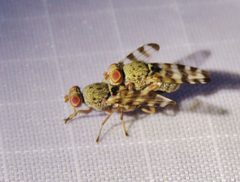
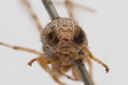
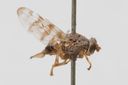
Pseudotephritina cribellum is a of ulidiid fly, commonly known as a picture-winged fly, in the Ulidiidae. The species was first described by Hermann Loew in 1873 and was originally placed in the Myennis before being reassigned to Pseudotephritina. Like other members of its family, it possesses distinctive patterned wings that give the group its . The species is known from the United States, though specific details about its remain poorly documented in published literature.
Pronunciation
How to pronounce Pseudotephritina cribellum: /ˌsjuːdoʊˌtɛfˈrɪtɪnə kraɪˈbɛləm/
These audio files are automatically generated. While they are not always 100% accurate, they are a good starting point.
Identification
Members of the Ulidiidae can be recognized by their patterned wings, which often display dark bands or spots that create a picture-like appearance. The Pseudotephritina can be distinguished from the related genus Myennis by subtle differences in wing venation and body proportions, though precise diagnostic features for P. cribellum specifically are not well documented in readily available sources. Specimens require examination under magnification for definitive identification.
Images
Distribution
United States.
Similar Taxa
- MyennisPseudotephritina was historically classified within Myennis, and of both share the picture-winged appearance and general body plan characteristic of Ulidiidae. The two genera can be separated by differences in wing venation and genitalia structure.
- Other UlidiidaeNumerous other within Ulidiidae share the patterned wing appearance that defines the . Distinguishing P. cribellum from these requires detailed examination of wing patterns and body .
More Details
Taxonomic History
This was originally described as Myennis cribellum by Loew in 1873. It has since been transferred to the Pseudotephritina, though the exact timing and authority for this transfer is not specified in the available sources. The Wikipedia entry still notes the historical placement in Myennis.
Data Availability
Published information about this is extremely limited. The iNaturalist platform records 46 observations, suggesting the species is encountered with some regularity by naturalists, but detailed biological studies appear to be lacking.
Sources and further reading
- BugGuide
- Wikipedia
- GBIF taxonomy match
- iNaturalist taxon
- Catalogue of Life
- Learning How Efficiently Spiders Capture Their Prey | Bug Squad
- Bug Eric: Spider Sunday: Triangle Spiders
- Bug Eric: Spider Sunday: Featherlegged Orb-weavers
- Bug Eric: Spider Sunday: Crevice Weavers
- Bug Eric: Spider Sunday: Coras
- Bug Eric: September 2009