
Euarestoides acutangulus
(Thomson, 1869)
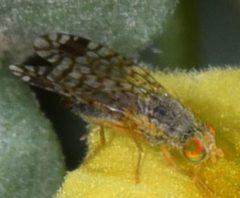
Euarestoides acutangulus is a of fruit fly in the Tephritidae, one of six recognized species in the Euarestoides. It has the broadest geographic distribution of any species in the genus, occurring across much of the Americas from Canada to Chile. The species is associated with plants in the Asteraceae family, particularly Ambrosia (ragweeds) and related genera. Larval development occurs within the flower of plants.
Pronunciation
How to pronounce Euarestoides acutangulus: /juːaˈrɛstoʊ.iːdz æˌkjuːtæŋˈɡjuːləs/
These audio files are automatically generated. While they are not always 100% accurate, they are a good starting point.
Identification
Euarestoides acutangulus can be distinguished from by the combination of wing pattern and body coloration; the exhibits characteristic markings on the wings typical of the but with specific pattern elements that separate it from E. abstersus, E. bimaculatus, E. dreisbachi, E. pereirai, and E. rionegrensis. A key to all six species of Euarestoides is provided in Savaris & Norrbom (2019).
Images
Habitat
Found in supporting its plants in the Asteraceae, including disturbed areas, grasslands, and semi-arid regions where Ambrosia and related occur.
Distribution
Canada, Chile, Colombia, Cuba, Dominican Republic, Ecuador, Mexico, Peru, Puerto Rico, Trinidad & Tobago, USA, and Venezuela.
Diet
feed on nectar and other plant fluids. Larvae develop within flower of plants, feeding on developing florets and seeds.
Host Associations
- Ambrosia acanthicarpa - larval
- Ambrosia confertiflora - larval
- Ambrosia dumosa - larval
- Ambrosia chenopodiifolia - larval
- Ambrosia eriocentra - larval
- Ambrosia ilicifolia - larval
- Ambrosia psilostachya - larval
- Hymenoclea salsola - larval
- Dicoria canescens - larval
- Iva axillaris - larval
- Baccharis halimifolia - larval
- Baccharis neglecta - larval
- Helianthus annuus - larval
Life Cycle
Complete with , larva, pupa, and stages. Larvae develop within the flower (capitula) of plants. Specific developmental timing varies with latitude and host plant .
Ecological Role
Flower inhabitant; larval feeding reduces seed production in plants. May contribute to biological regulation of weedy Ambrosia .
Similar Taxa
- Euarestoides abstersusOverlaps in distribution (eastern North America) but distinguished by wing pattern and male genitalia; E. abstersus is restricted to Bahamas, eastern Canada and USA versus the much broader range of E. acutangulus
- Euarestoides dreisbachiOverlaps in Mexico and Peru; distinguished by specific wing markings and body coloration per key