
Dioxyna
Frey, 1945
Species Guides
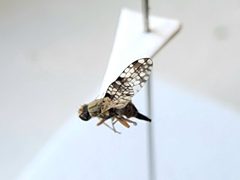
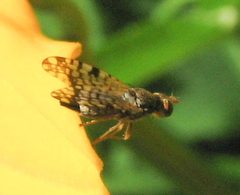
2Dioxyna is a of fruit flies in the Tephritidae, containing approximately 10 described . The genus was established by Frey in 1945. Species within this genus are associated with plants in the Asteraceae family, where courtship, mating, and oviposition occur. Detailed behavioral studies exist for at least one species, D. sororcula, revealing complex mating systems including territoriality and mate guarding.

Pronunciation
How to pronounce Dioxyna: /daɪˈɒksɪnə/
These audio files are automatically generated. While they are not always 100% accurate, they are a good starting point.
Identification
Dioxyna can be distinguished from related tephritid by wing pattern characteristics typical of the tribe Tephritini, though specific diagnostic features for the genus require examination. The genus is currently treated as a synonym of Campiglossa in some taxonomic databases, creating potential confusion in identification.
Images
Habitat
Associated with flowering plants, particularly Asteraceae. For D. sororcula, males establish and defend territorial leaf areas where females feed, and courtship and mating occur on flower disc surfaces.
Distribution
Records from Denmark, Norway, and Sweden (GBIF). Individual have broader distributions: D. sororcula occurs in Australia; D. thomae has observations from multiple locations; D. chilensis is present in South America.
Host Associations
- Callendula officinalis - oviposition site; courtship and mating venueDocumented for D. sororcula; flower serve as site for female oviposition and location for courtship
Behavior
Males of D. sororcula defend territorial leaf areas where females feed. Courtship involves males approaching females and performing a wing display with wings vibrated while held at 45° above the body. Copulation occurs on leaf surfaces, initiated by males mounting from behind. Post-copulatory mate guarding occurs, with males remaining mounted on females for several minutes after copulation ends. Copulation duration averages 35 minutes. use was ruled out in D. sororcula, as potential mates could not recognize each other beyond 1.5 cm.
Similar Taxa
- CampiglossaDioxyna is treated as a synonym of Campiglossa in Catalogue of Life and some other databases, indicating close taxonomic relationship and potential similarity in and
More Details
Taxonomic status note
The Dioxyna has an unstable taxonomic status. While accepted as a valid genus in some sources (GBIF, original description), Catalogue of Life treats it as a synonym of Campiglossa. The GBIF entry notes a 'HIGHERRANK' match type, suggesting potential classification complexities. Researchers should verify current taxonomic treatment when using this name.
Behavioral data limitation
Detailed behavioral information is available only for D. sororcula. Generalization of these traits to other Dioxyna should be made with caution, as mating systems and associations may vary across the .