
Silba fumosa
(Egger, 1862)
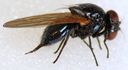
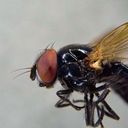
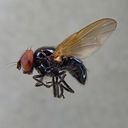
Silba fumosa is a small lance fly in the Lonchaeidae, reaching approximately 4 millimeters in body length. The exhibits metallic dark blue coloration with in sheen: males have a dull mesonotum while females display a shiny midline. It is native to the Palearctic region and has been documented in mature woodland . The species is distinct from the congeneric black fig fly (Silba adipata), a major agricultural pest.
Pronunciation
How to pronounce Silba fumosa: /ˈsɪl.ba fuːˈmoː.sa/
These audio files are automatically generated. While they are not always 100% accurate, they are a good starting point.
Identification
Distinguished from similar Lonchaeidae by the combination of metallic dark blue body, in sheen, black legs, and brownish wings. The light seta fringe on the tegulum is a notable diagnostic feature. Differs from Silba adipata (black fig fly), which has reddish , brown legs, and black (not metallic blue) coloration.
Images
Appearance
Body approximately 4 mm in length with metallic dark blue coloration. dull in males, shiny along the middle in females. Legs black. Wings brownish. Tegulum bears a light seta fringe.
Habitat
Mature woodland
Distribution
Palearctic region. Documented presence in Norway and Sweden.
Similar Taxa
- Silba adipataBlack fig fly is congeneric but differs in coloration ( black vs. metallic dark blue), color (reddish vs. not specified), leg color (brown vs. black), and is a specialized fig pest with different requirements
More Details
Taxonomic note
Silba fumosa is not to be confused with the economically significant Silba adipata (black fig fly), an pest of figs that has spread to California. The two differ in coloration, , and .
Sources and further reading
- BugGuide
- Wikipedia
- GBIF taxonomy match
- iNaturalist taxon
- NCBI Taxonomy
- Catalogue of Life
- Meloidae Holdings | Entomology Research Museum
- black fig fly (Silba adipata) - Entomology Today
- black fig fly (Silba adipata) - Entomology Today
- Silba adipata Archives - Entomology Today
- Black Fig Fly: A New Invasive Pest in California
- McPhail trap - Entomology Today