
Hybomitra affinis
(Kirby, 1837)
moose-fly
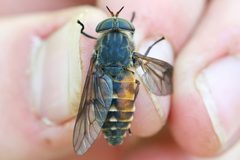
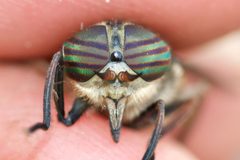
Pronunciation
How to pronounce Hybomitra affinis: /haɪ.boʊˈmaɪ.trə əˈfɪ.nɪs/
These audio files are automatically generated. While they are not always 100% accurate, they are a good starting point.
Images
Habitat
Dominantly woodland . Larvae develop in saturated moss or other predominantly organic materials around swampy woodland pools, marshy lakeshores, willow swamps, and sphagnum bogs.
Distribution
North America, from western Alaska to easternmost Canada, extending south to Arizona in the west and New England in the east. Distribution records include Vermont, USA.
Behavior
Only females bite.
Human Relevance
Important pest throughout its range. Females bite humans and other mammals. Among the Naskapi of Sept-Îles, Quebec, known as misəna'k‘w; among Mistassini Naskapi as mici˙cak‘w (meaning "big biter"); and among Lake St. John Naskapi as mi◌̇ctsina'k‘w. Also known as "he who governs fish" or "the master of the fish" (Naskapi təpənəmə'k nəme'c, Mistassini katəpe˙'i˙mat nəme'ca), believed to visit fishermen to ensure fish are not wasted, biting to maintain mindfulness of this surveillance.
Sources and further reading
- BugGuide
- Wikipedia
- GBIF taxonomy match
- iNaturalist taxon
- NCBI Taxonomy
- Catalogue of Life
- Meet 'Mantis Master Keeper' Andrew Pfeifer | Bug Squad
- Saving the Rusty-Patched Bumble Bee | Bug Squad
- Take 2 on tropical tiger moths: Spotted oleander caterpillar moth, Empyreuma affinis — Bug of the Week
- Mason bees in peril when parasitic wasps arrive – Leucospid wasp, Leucospis affinis — Bug of the Week
- A Tick that Feeds on Birds May Increase the Range of Lyme Disease
- Genetic Analysis Guides Conservation of Endangered Bumble Bee