
Parhelophilus rex
Curran & Fluke, 1922
Dusky Bog Fly
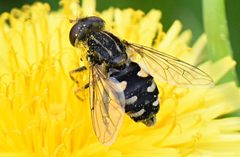
Parhelophilus rex, commonly known as the Dusky Bog Fly, is a syrphid fly described by Curran and Fluke in 1922. It occurs in northern North America and is considered fairly common within its range. Like other hoverflies, are capable of nearly motionless and are frequently observed visiting flowers for nectar and pollen. The larval stage remains undescribed.
Pronunciation
How to pronounce Parhelophilus rex: /pɑːˈhiːloʊfɪləs rɛks/
These audio files are automatically generated. While they are not always 100% accurate, they are a good starting point.
Identification
A member of the Parhelophilus, which contains often associated with wetland . Specific diagnostic features distinguishing P. rex from are not documented in available sources. The species epithet "rex" and "Dusky Bog Fly" suggest darker coloration and bog-associated , but explicit morphological characters are not stated.
Images
Habitat
Associated with bog based on the "Dusky Bog Fly." Specific microhabitat requirements for larvae are unknown. are found on flowers in areas near their wetland breeding sites.
Distribution
Northern North America. Specific records include Vermont, USA. The is described as fairly common within this northern range.
Diet
feed on nectar and pollen from flowers. Larval diet is unknown.
Life Cycle
Complete with , larva, pupa, and stages. Larval and developmental details are undescribed.
Behavior
exhibit hovering capability characteristic of Syrphidae, allowing nearly motionless position in air. Adults are flower visitors.
Ecological Role
contribute to pollination through flower visitation. Specific functions of larvae are unknown due to undescribed larval .
Similar Taxa
- Parhelophilus spp.Other members of the share wetland associations and general hoverfly ; specific separation characters from are not documented.
Sources and further reading
- BugGuide
- Wikipedia
- GBIF taxonomy match
- NCBI Taxonomy
- Catalogue of Life
- Oedipodine Rex | Beetles In The Bush
- More on ‘Conspicuous Crypsis’ | Beetles In The Bush
- treehopper | Beetles In The Bush
- New Guinea | Blog
- Ozark Landscapes – White River in northern Arkansas | Beetles In The Bush
- Pelecinidae | Beetles In The Bush