
Palpada pusilla
(Macquart, 1842)
Bicolored Plushback
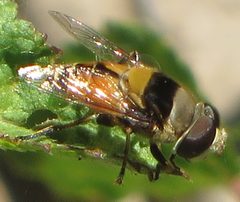
Palpada pusilla is a of syrphid fly in the Syrphidae, commonly known as the Bicolored Plushback. It is a member of the tribe Eristalini, which includes species whose larvae are known as "rat-tailed maggots" due to their distinctive breathing siphon. The species has been documented across all 27 states of Brazil based on distribution records. flies are that visit flowers, while larvae develop in organic-rich aquatic environments.


Pronunciation
How to pronounce Palpada pusilla: //pælˈpeɪdə puːˈsɪlə//
These audio files are automatically generated. While they are not always 100% accurate, they are a good starting point.
Images
Distribution
Brazil: documented in all 27 states including Acre (BR-AC), Alagoas (BR-AL), Amazonas (BR-AM), Amapá (BR-AP), Bahia (BR-BA), Ceará (BR-CE), Distrito Federal (BR-DF), Espírito Santo (BR-ES), Goiás (BR-GO), Maranhão (BR-MA), Minas Gerais (BR-MG), Mato Grosso do Sul (BR-MS), Mato Grosso (BR-MT), Pará (BR-PA), Paraíba (BR-PB), Pernambuco (BR-PE), Piauí (BR-PI), Paraná (BR-PR), Rio de Janeiro (BR-RJ), Rio Grande do Norte (BR-RN), Rondônia (BR-RO), Roraima (BR-RR), Rio Grande do Sul (BR-RS), Santa Catarina (BR-SC), Sergipe (BR-SE), São Paulo (BR-SP), and Tocantins (BR-TO).
Life Cycle
Larvae of Palpada , like other Eristalini, possess an extensible breathing siphon that allows them to inhabit low-oxygen aquatic environments while maintaining contact with the water surface. Mature larvae seek dry land to pupate, forming a hard pupal capsule.
Ecological Role
function as , visiting wildflowers and cultivated blossoms. Larvae contribute to decomposition and nutrient cycling in organic-rich aquatic .