
Myolepta strigilata
(Loew, 1872)
Scaled Pegleg
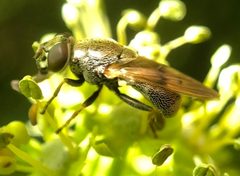
Myolepta strigilata, commonly known as the Scaled Pegleg, is an uncommon syrphid fly found in the eastern and central United States. are flower visitors that feed on nectar and pollen. The is part of the hoverfly , capable of sustained hovering . Larvae of the develop in rot holes of deciduous trees.
Pronunciation
How to pronounce Myolepta strigilata: //maɪəˈlɛptə ˌstrɪdʒɪˈleɪtə//
These audio files are automatically generated. While they are not always 100% accurate, they are a good starting point.
Identification
The 'Scaled Pegleg' refers to distinctive leg characteristics, though specific diagnostic features for separating this from are not documented in available sources. As an uncommon species with few observations, field identification to species level may require examination.
Images
Habitat
Associated with deciduous forest environments where larval development occurs in tree rot holes. frequent flowering vegetation in wooded or edge .
Distribution
Eastern and central United States.
Diet
feed on nectar and pollen from flowers. Larval diet unknown for this ; larvae of the develop in decaying wood and associated organic matter in tree cavities.
Life Cycle
Complete with , larva, pupa, and stages. Larvae develop in rot holes of deciduous trees, though specific details for this are not documented.
Behavior
hover at flowers to feed. includes sustained hovering capability characteristic of the .
Ecological Role
may contribute to pollination through flower visitation. Larvae in tree rot holes participate in decomposition processes in forest .
Human Relevance
No documented economic or medical significance. Occasionally observed by naturalists and documented on citizen science platforms.
Similar Taxa
- Other Myolepta speciesCongeneric share similar associations and general ; distinguishing features require detailed examination and may not be apparent in field observation.
- Other syrphid fliesGeneral hoverfly appearance and overlap with many Syrphidae; leg scaling and specific wing venation patterns may aid separation.
More Details
Observation frequency
Considered uncommon with only 28 observations documented on iNaturalist as of source date, suggesting either genuine rarity or underdetection due to identification challenges.
Larval biology
While larvae of Myolepta are known from tree rot holes, specific larval and exact feeding habits for M. strigilata have not been described separately from the -level pattern.