
Microchrysa polita
(Linnaeus, 1758)
black-horned gem, black-horned gem fly
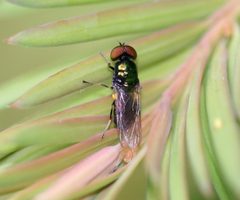
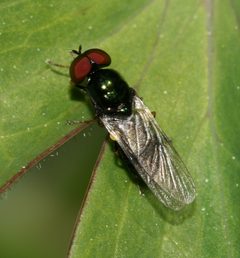
Microchrysa polita, commonly known as the black-horned gem or black-horned gem fly, is a small of soldier fly in the Stratiomyidae. are active from March through September and are found in deciduous woodland edges, hedgerows, gardens, and parks across Europe, Asia, and North America. The species is notable for its distinctive black and predominantly black legs.
Pronunciation
How to pronounce Microchrysa polita: /maɪkroʊˈkraɪsə ˈpɒlɪtə/
These audio files are automatically generated. While they are not always 100% accurate, they are a good starting point.
Identification
Distinguished from other Microchrysa by the combination of entirely black and predominantly black legs. Males can be identified by the presence of black on the middle part of the and on the . The small size (4.5–5.5 mm) and black-horned appearance separate it from larger or differently colored soldier flies.
Images
Appearance
Small soldier fly with body length of 4.5–5.5 mm. entirely black. Legs predominantly black. In males, the on the middle part of the and on the is black. The "black-horned gem" refers to the black antennae.
Habitat
Deciduous woodland edges, wooded areas, hedgerows, gardens, and parks. Larval include soil, decomposing grass and leaves, and compost.
Distribution
Europe, Asia, and North America. Specific records include Russia, Siberia, Central Asia, Mongolia, Western Europe, United States, and Canada.
Seasonality
period from March to September.
Life Cycle
Larvae have been found in soil, decomposing grass and leaves, and compost. Specific details of , pupal stages, and complete developmental timeline are not documented.
Behavior
are and active during daylight hours. Larvae are found in decomposing organic matter and soil.
Ecological Role
Larvae contribute to decomposition of organic matter in soil and compost . may serve as when visiting flowers.
Human Relevance
Occasionally encountered in gardens and parks, where it is likely overlooked due to small size. No known economic or medical significance.
Similar Taxa
- Other Microchrysa speciesSimilar small size and general body form, but distinguished by black and leg coloration in M. polita
- Other StratiomyidaeSoldier flies share general body plan, but M. polita is separable by size and the distinctive black referenced in its