
Leptocera erythrocera
(Becker, 1919)
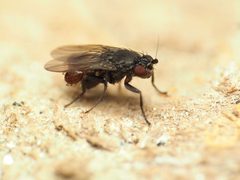
Leptocera erythrocera is a small fly in the Sphaeroceridae, commonly known as lesser dung flies. The was described by Becker in 1919. It has been recorded from Hawaii and is part of a characterized by reduced wing venation and small body size. Like other members of Sphaeroceridae, it likely inhabits decomposing organic matter, though specific ecological details remain limited.
Pronunciation
How to pronounce Leptocera erythrocera: /lɛp.toʊˈsɪə.rə ɛˌrɪθ.roʊˈsɪə.rə/
These audio files are automatically generated. While they are not always 100% accurate, they are a good starting point.
Identification
Identification to level requires examination of male terminalia and subtle characters of wing venation and chaetotaxy. Separation from other Leptocera species, particularly within the Hawaiian fauna, necessitates reference to original species descriptions and specialized keys for Sphaeroceridae.
Images
Appearance
Small-bodied dipteran with reduced wing venation characteristic of Sphaeroceridae. Specific morphological features distinguishing L. erythrocera from have not been detailed in accessible literature.
Habitat
Specific preferences are undocumented. Based on -level characteristics, occurrence in association with decomposing organic substrates including and compost is probable.
Distribution
Recorded from Hawaii, United States. The extent of its range beyond the Hawaiian Islands is unknown.
Similar Taxa
- Other Leptocera speciesCongeneric share reduced wing venation, small size, and general body plan. Differentiation requires detailed morphological examination.
- Other Sphaeroceridae genera members exhibit convergent small size and simplified wing venation. -level assignment depends on antennal structure and chaetotaxy patterns.
More Details
Taxonomic authority discrepancy
GBIF records authority as (Becker, 1919) while NCBI lists (Becker, 1920). The original publication year should be verified against primary literature.
Data limitations
Despite 52 iNaturalist observations, accessible published information on , , and of this appears sparse. Most available knowledge derives from -level generalizations rather than species-specific study.