
Saltella sphondylii
(Schrank, 1803)
Saltella sphondylii is a European sepsid fly notable for its highly unusual mating system in which females mount males during copulation. This has been extensively studied as a model for the costs of , particularly the reduced male longevity associated with multiple copulations. The mating involves distinctive elements including multiple insertions of a comparatively membranous phallus, pre-copulatory wing displays by males, and post-copulatory mate guarding. It is a member of the Sepsidae, a group of small flies often associated with and decaying organic matter.
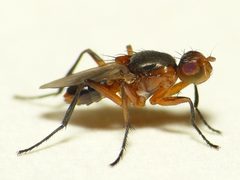
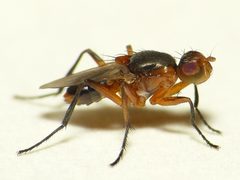
Pronunciation
How to pronounce Saltella sphondylii: //sælˈtɛlə sfɒnˈdɪli.aɪ//
These audio files are automatically generated. While they are not always 100% accurate, they are a good starting point.
Identification
Saltella sphondylii can be distinguished from other sepsid flies by its membranous phallus , which is notably less sclerotized than that of related such as Themira putris, Parapaleosepsis plebeia, and Sepsis punctum. The species' unique mating posture—females mounting males—provides a behavioral diagnostic when observed. Detailed morphological identification requires examination of male genitalia.
Images
Distribution
Recorded from Belgium (including Flemish and Walloon regions), Denmark, and Norway. Described as a European .
Behavior
Mating involves females mounting males, a reversal of the typical sepsid mating posture. Copulation bouts feature multiple insertions of the male's membranous phallus and are prolonged in duration. Males perform distinctive pre-copulatory wing displays. Post-copulatory mate guarding has been observed. These five behavioral elements were identified through frame-by-frame video analysis.
Similar Taxa
- Themira putrisSimilar sepsid fly with more sclerotized phallus ; used in comparative studies of genital evolution
- Parapaleosepsis plebeiaSimilar sepsid fly with more sclerotized phallus ; used in comparative studies of genital evolution
- Sepsis punctumSimilar sepsid fly with more sclerotized phallus ; used in comparative studies of genital evolution
More Details
Male longevity costs
Multiple copulations reduce male lifespan, hypothesized to result from the energetic or physiological demands of copulation bouts involving multiple phallus insertions.
Research significance
Widely cited as a model organism for studying the evolution of mating and the costs of in insects.