
Coelopa frigida
(Fabricius, 1805)
seaweed fly, kelp fly
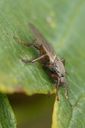
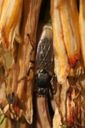
Coelopa frigida is a and the most widely distributed in its , found on temperate Northern Hemisphere shorelines with stranded . are 5–6 mm with dark brown to black bodies, lighter legs, and large translucent wings. The species exhibits a chromosomal (αβ system) that generates two distinct size morphs with different developmental rates and life-history strategies. It has become a model organism for studying , particularly female choice and sexual conflict, and for investigating the genetic basis of local through chromosomal inversions.

Pronunciation
How to pronounce Coelopa frigida: /ˈsɛl.oʊ.pə ˈfrɪdʒ.ɪ.də/
These audio files are automatically generated. While they are not always 100% accurate, they are a good starting point.
Identification
Distinguished from by its widespread distribution and association with temperate Northern Hemisphere coastlines. Coelopa nebularum, potentially a or recent derivative, is morphologically similar and requires genetic analysis for definitive separation. Coelopa pilipes co-occurs on British beaches and shows different stable isotope signatures and metabolic processes, though field identification is challenging. The combination of dark body, variable leg coloration, six tergites, and specificity to stranded kelp beds supports identification.
Images
Appearance
are 5–6 mm in body length with dark brown to black coloration. The legs range from light brown to yellow to black. Large, translucent wings span approximately 6 mm. Most individuals possess six tergites with accompanying bristles (setae) that vary in length and are black or match tergite color. Body size is genetically determined by the αβ chromosomal : α homozygotes are larger with more developed 'peacock's tail' structures, while β homozygotes are smaller and develop faster. The is covered with dense waterproofing hairs.
Habitat
Strictly coastal, restricted to beaches with accumulations of stranded seaweed (wrackbeds). Requires constant supply of decaying brown and green (primarily Laminaria and Fucus ) for feeding and oviposition. is determined by algae age, wind and storm exposure, decomposition rate, and temperature. Microhabitat selection includes preference for high-temperature zones within wrackbeds for oviposition.
Distribution
Temperate Northern Hemisphere coastlines. Documented range extends along the North Atlantic Coast to Iceland, encompassing coasts of Russia, the North Sea, Faroe Islands, British Isles, and Belgium. Pacific Coast of North America, Japan's Kuril Islands, and eastern Russian coasts also reported. The most widely distributed .
Seasonality
Activity tied to availability of stranded . Higher temperatures accelerate both algal decomposition and development; lower temperatures prolong algal freshness and extend egg incubation. Storms and harsh weather reduce life expectancy. blooms have increased with climate change due to greater algal deposition.
Diet
and larvae feed on decaying seaweed, particularly Laminaria and Fucus . Larvae burrow into stranded and consume bacteria coating the decaying tissue. The precise nutritional contribution of seaweed tissue versus microorganisms remains under investigation. Stable isotope analysis indicates that wild may incorporate red algae or distinct bacterial not replicated in laboratory conditions.
Life Cycle
Complete with time approximately 30 days. Females lay up to five clutches of 80 each, deposited en masse in leaves of stranded . Egg stage averages 12.25 days but varies with temperature and alcohol dehydrogenase ; higher temperatures accelerate hatching. Larvae develop through three instars, with third instars showing patchy spatial distribution due to temperature-zone oviposition preferences and . occurs within the algal matrix. emerge with wings initially folded, expanding to 6 mm upon drying; legs elongate and develop hooked attachments for gripping seaweed.
Behavior
Forms lekking on stranded . typically remain in natal seaweed patch until it returns to ocean, then disperse to locate alternative algae. Highly waterproof due to specialized exoskeletal hairs; can survive submersion and vigorous shaking in seawater, emerging dry to fly back to shore. Mating involves male mounting with prothoracic legs contacting female ; females perform rejection . No apparent interaction between flies at distances greater than 1–2 cm. Larger males displace smaller males in competitive interactions; size-assortative mating occurs. Polygynous mating system with males seeking multiple receptive females and females devoting resources to production.
Ecological Role
Specialized decomposer of stranded marine , facilitating nutrient cycling in coastal . Serves as prey for seabirds including purple sandpiper (Calidris maritima), though birds only access surface and do not penetrate wrackbeds to reach and larvae. to the mite Thinoseius fucicola. Competes with Coelopa pilipes for algal resources.
Human Relevance
Occasional pest during blooms associated with climate change, when annoy beachgoers and may be blown inland. Important model organism for laboratory studies of , female choice, sexual conflict, and the genetic architecture of through chromosomal .
Similar Taxa
- Coelopa nebularumPossibly or recently speciated derivative; morphologically similar and genetically close, requiring molecular analysis for definitive identification. Taxonomic status remains disputed.
- Coelopa pilipesCo-occurring competitor on British beaches; distinguished by different stable isotope signatures, metabolic processes, and behavioral , though field identification is difficult.
Sources and further reading
- BugGuide
- Wikipedia
- GBIF taxonomy match
- NCBI Taxonomy
- Mating behavior in seaweed flies (Coelopa frigida)
- On the distribution of recessive embryonic lethals in a natural population ofCoelopa frigida(Fab.)
- The function of female behaviours adopted during premating struggles in the seaweed fly, Coelopa frigida
- Female mating behaviour, sexual selection and chromosome I inversion karyotype in the seaweed fly, Coelopa frigida
- Structures associated with the nucleus during chromatin condensation in Coelopa frigida (Diptera) spermiogenesis
- The inheritance of female mating behaviour in the seaweed fly,Coelopa frigida
- Investigating dietary preferences in two competing dipterans, Coelopa frigida and Coelopa pilipes, using stable isotope ratios of carbon and nitrogen
- Genetic divergence and phenotypic plasticity contribute to variation in cuticular hydrocarbons in the seaweed fly Coelopa frigida
- Karyotype-environment associations support a role for a chromosomal inversion in local adaptation in the seaweed fly Coelopa frigida
- The effect of habitat composition on sexual conflict in the seaweed flies Coelopa frigida and C. pilipes
- Different rates of development associated with the alcohol dehydrogenase locus in the seaweed fly, Coelopa frigida