
Coelopa
Meigen, 1830
Bristly Kelp Flies, kelp flies, seaweed flies
Species Guides
2- Coelopa frigida(seaweed fly)
- Coelopa vanduzeei(kelp fly)
Coelopa is a of kelp flies comprising approximately 13-14 described . These flies are obligate associates of stranded seaweed (wrackbeds) in coastal environments, where they complete their entire . The genus is notable for extensive research on , chromosomal , and ecological genetics, particularly in the well-studied species Coelopa frigida. Species within this genus exhibit resource competition and dietary partitioning where sympatric.
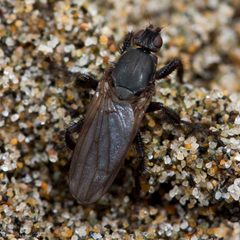
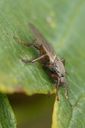
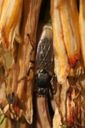
Pronunciation
How to pronounce Coelopa: /siːˈloʊpə/
These audio files are automatically generated. While they are not always 100% accurate, they are a good starting point.
Identification
-level identification requires examination of morphological characters; C. frigida is often confused with C. nebularum and C. pilipes due to morphological similarity. Subgeneric classification based on male genitalia and other structural features: Coelopa (sensu stricto), Fucomyia, and Neocoelopa.
Images
Habitat
Strictly coastal; found in wrackbeds—accumulations of decaying seaweed (macroalgae) stranded on shorelines. and larvae occupy the intertidal zone where kelp and other macroalgae accumulate. Temperature zones within wrackbeds influence microhabitat selection.
Distribution
Temperate Northern Hemisphere for C. frigida; broader distribution includes Europe (Sweden, Denmark, Norway), North America, and other coastal regions. GBIF records confirm presence in Denmark, Norway, and Sweden. Latitudinal documented in both Europe and North America.
Diet
Larvae and feed on decaying macroalgae (seaweed). Stable isotope analysis confirms macroalgae (Laminaria spp., Fucus spp.) as primary carbon source. Where sympatric, C. frigida consumes more animal-derived material (higher δ15N values) while C. pilipes feeds more herbivorously, indicating dietary partitioning.
Life Cycle
Holometabolous. laid in high-temperature zones within wrackbeds. Larvae develop through three instars; third-instar larvae exhibit patchy spatial distribution due to temperature preferences and aggregate formation. occurs within wrackbed substrate.
Behavior
show no apparent interaction beyond 1–2 cm distance prior to mating. Males mount females and use prothoracic legs to contact female to facilitate mating. Larger males displace smaller rivals in competitive situations. Female rejection responses and male voluntary dismounts occur. Strong size-assortative and -assortative mating documented.
Ecological Role
Decomposer and processing stranded kelp in coastal . Contributes to nutrient cycling in wrackbed . Dietary partitioning between competing may facilitate coexistence and maintain diversity in wrackbed microhabitats.
Human Relevance
Research model for studies of , chromosomal , local , and genetics. The αβ inversion system on I has been extensively studied for its role in determining male size and female mating preferences.
Similar Taxa
- Coelopa nebularumMorphologically similar to C. frigida; often confused in identification
- Coelopa pilipesMorphologically similar to C. frigida; sympatric competitor with dietary partitioning
More Details
Chromosomal Inversion Polymorphism
The αβ on I is widespread and conserved between European and North American . Three karyotypes show different across microhabitats, representing alternative life-history strategies maintained by balancing selection. Inversion frequency correlates with environmental variables including temperature.
Genetic Load
Natural harbor substantial recessive embryonic lethal genetic load (44 lethals from 528 tested in one population, 1957-1959). Certain lethals are repeated within , with gene frequencies exceeding expectations based on population size.
Sources and further reading
- BugGuide
- Wikipedia
- GBIF taxonomy match
- iNaturalist taxon
- NCBI Taxonomy
- Catalogue of Life
- Mating behavior in seaweed flies (Coelopa frigida)
- Investigating dietary preferences in two competing dipterans, Coelopa frigida and Coelopa pilipes, using stable isotope ratios of carbon and nitrogen
- On the distribution of recessive embryonic lethals in a natural population ofCoelopa frigida(Fab.)
- The inheritance of female mating behaviour in the seaweed fly,Coelopa frigida
- The function of female behaviours adopted during premating struggles in the seaweed fly, Coelopa frigida
- Female mating behaviour, sexual selection and chromosome I inversion karyotype in the seaweed fly, Coelopa frigida
- Studies on the biology of the kelp-flyCoelopain Great Britain
- Structures associated with the nucleus during chromatin condensation in Coelopa frigida (Diptera) spermiogenesis
- The effect of habitat composition on sexual conflict in the seaweed flies Coelopa frigida and C. pilipes
- Karyotype-environment associations support a role for a chromosomal inversion in local adaptation in the seaweed fly Coelopa frigida