
Lonchoptera
Meigen, 1803
spear-winged flies
Species Guides
2- Lonchoptera bifurcata(Small Grass Fly)
- Lonchoptera uniseta
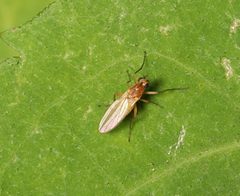
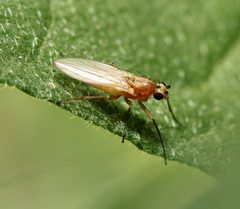
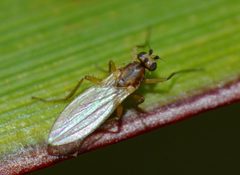
Lonchoptera is a of small, slender flies in the Lonchopteridae, commonly called spear-winged flies. measure 2–5 mm and are yellow to brownish-black with bristly bodies. The genus is distinguished by pointed wingtips with sexually dimorphic venation. Larvae are dorsally flattened with two pairs of bristles and develop in decaying organic matter.
Pronunciation
How to pronounce Lonchoptera: /lɒŋˈkɑptərə/
These audio files are automatically generated. While they are not always 100% accurate, they are a good starting point.
Identification
Distinguished from other Lonchopteridae by: foreleg tibiae with setae in the middle; foreleg thinner than foreleg tibiae; pointed wingtip lacking an brown spot. Wings are subacute (pointed) with venation that differs between sexes.
Images
Habitat
Associated with decaying vegetable matter and crop litter. Larvae develop in rotting plant material including vegetable debris and cereal .
Distribution
Recorded from Denmark, Norway, Sweden, and the United States (Vermont). Specific study of Lonchoptera lutea documented in southern England.
Diet
Larvae feed on rotting vegetable matter and fungal spores. : diet not documented.
Life Cycle
Larval development occurs in decaying litter. In Lonchoptera lutea, success depends on soil moisture during May–June and avoidance of excessive sunshine.
Human Relevance
Present in cereal crops such as winter wheat. Abundance correlates with years of high shoot borer damage (, ), though the nature of this association is unclear.