
Lonchopteridae
Macquart, 1835
spear-winged flies
Genus Guides
1- Lonchoptera(spear-winged flies)
is a small of Diptera commonly known as spear-winged flies, characterized by distinctive wings with pointed tips. The family contains approximately 50 worldwide, primarily in the Lonchoptera. Species are found in diverse including upland blanket bogs, mineral soils, peatlands, and lowland bogs. Some species exhibit parthenogenetic , with males rare or absent across most of the range. The family has been documented in the Palearctic, Nearctic, and other regions.
Pronunciation
How to pronounce Lonchopteridae: //ˌlɒŋkoʊptəˈraɪdiː//
These audio files are automatically generated. While they are not always 100% accurate, they are a good starting point.
Identification
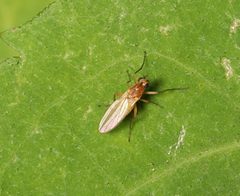
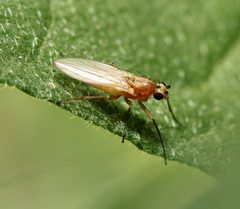
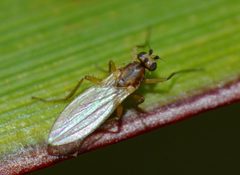
are small, slender flies with distinctive (spear-shaped) wings that taper to a pointed apex, a feature unique among Diptera. Wing venation is reduced, with few crossveins. are short and aristate. The body is typically yellowish to brownish in coloration. Identification to level requires examination of male genitalia and chaetotaxy; females of some species are difficult to distinguish morphologically.
Images
Habitat
occupy diverse moist including upland blanket bog, upland mineral soils, shallow peat soils, and lowland bogs. In northern England, Lonchoptera furcata occurs commonly on upland mineral soils, shallow peat soils, and lowland bogs, while L. lutea is most abundant on upland blanket bog. Habitat associations show considerable species separation at local .
Distribution
Widespread in the Palearctic and Nearctic regions. In northern England, documented at forty upland sites with two recorded. Nearctic distribution includes Canada (British Columbia, Manitoba, Newfoundland, Northwest Territories, Ontario, Quebec, Yukon), USA (Alaska, California, Iowa, Michigan, Minnesota, New Hampshire), with additional records from Denmark, Norway, and Sweden.
Seasonality
activity varies by and altitude. Lonchoptera lutea shows similar seasonal capture patterns across all altitudes. Lonchoptera furcata exhibits altitudinally stratified : males captured mid-summer above 420 m elevation, and October-December at lower elevations; females follow the same trend but with partially obscured patterns due to longer lifespan. This suggests a possible shift from to biannual lifecycle at higher elevations.
Similar Taxa
- EmpididaeSimilar small, slender body form, but distinguished by rounded or oval wing tips rather than the characteristic wings of .
- DolichopodidaeSimilar long-legged appearance in some , but have rounded wings with more complex venation and typically metallic coloration absent in .
More Details
Parthenogenesis
Lonchoptera furcata is predominantly parthenogenetic, with males occurring only in a small portion of the ' range. The capture of males in northern England is unusual and noteworthy. Male and female chaetotaxy patterns are consistent with those of continental European , confirming conspecificity and rejecting hypotheses that these males represent an undescribed species.
Sex ratios
In northern England , males comprised approximately 14% of L. furcata captures and 39% of L. lutea captures. The higher proportion of males in L. lutea suggests this may have more frequent or different reproductive mode compared to the predominantly parthenogenetic L. furcata.