
Macquartia
Robineau-Desvoidy, 1830
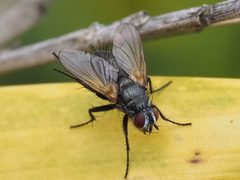
Macquartia is a of tachinid flies (Diptera: Tachinidae) in the tribe Macquartiini, Tachininae. The genus comprises approximately 29 described distributed across the Afrotropical, Oriental, Palearctic, and Nearctic regions. Species with documented are of Chrysomelidae larvae. Phylogenetic analyses indicate Macquartia represents one of the most ancient evolutionary lineages within Tachinidae and is sister to the tribe Myiophasiini.
Pronunciation
How to pronounce Macquartia: /mæˈkwɔːrt.i.ə/
These audio files are automatically generated. While they are not always 100% accurate, they are a good starting point.
Identification
Macquartia are characterized by the following combination of features: body length exceeding 4.0 mm; densely covered with long hairs; ocellar setae well-developed and proclinate (directed forward); postpedicel (third antennal segment) less than twice as long as the ; (antennal bristle) thickened on the basal one-fourth or less; scutellum usually black with strongly crossed setae; bare; and pre-apical posteroventral seta on the hind tibia distinctly shorter than the pre-apical anteroventral seta.
Images
Habitat
Collection records indicate occurrence in montane and forested . Specimens have been collected at elevations of approximately 2480 m in Sichuan Province, China, and from Dalaoling National Natural Reserve in Hubei Province, China, using . Specific microhabitat preferences are not documented.
Distribution
Widely distributed across the Afrotropical, Oriental, Palearctic, and Nearctic regions. In China, 16 are recorded, including recently described species from Sichuan and Qinghai provinces. GBIF records confirm presence in Denmark, Norway, and Sweden.
Host Associations
- Chrysomelidae larvae - with documented are of leaf beetle larvae (Coleoptera: Chrysomelidae)
Ecological Role
As of Chrysomelidae larvae, Macquartia may contribute to natural suppression of leaf beetle . This parasitoid relationship suggests potential utility in of agricultural and forest pest species, though specific applications have not been documented.
Similar Taxa
- Other Tachininae generaMacquartia is distinguished from other tachinine by the combination of bare , proclinate ocellar setae, and specific antennal proportions (postpedicel less than twice length). The tribe Macquartiini is considered sister to Myiophasiini based on phylogenetic analyses of mitochondrial .
More Details
Evolutionary significance
Phylogenetic analyses based on complete mitochondrial support the monophyly of Macquartia and identify it as representing one of the most ancient evolutionary lineages within Tachinidae. Ancestral tachinids, including the Macquartiini lineage, are inferred to be (-laying), with ovolarvipary (depositing larvae rather than eggs) arising independently in multiple derived lineages.
Taxonomic stability
The has been subject to recent taxonomic revision, with four new described from China in 2022 (M. brunneisquama, M. chinensis, M. flavifemorata, M. flavipedicel) and three additional new species described in 2023 (M. barkamensis, M. setifacies, M. sichuanensis), indicating ongoing discovery and documentation of diversity.