
Calliphora latifrons
Hough, 1899
blue bottle fly
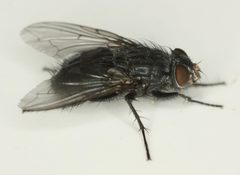
Calliphora latifrons is a of blow fly ( Calliphoridae) commonly known as a blue bottle fly. The species has limited geographic distribution in North America and is associated with undisturbed . It is considered one of the most forensically important blow fly species due to its predictable and patterns on carrion, which can be used to estimate postmortem intervals. are known to enter houses and breed in small carcasses.

Pronunciation
How to pronounce Calliphora latifrons: //kəˈlɪfərə ˈlætɪˌfrɒnz//
These audio files are automatically generated. While they are not always 100% accurate, they are a good starting point.
Identification
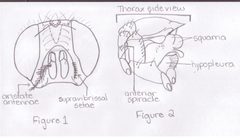
Distinguished from related Calliphora by: presence of presutural intra-alar seta; thoracic usually with brown setae (orange in C. latifrons specifically noted); facial ridge with distinctive row of short, stout supravibrissal setae; second set of strong divergent ocellar setae about 2/3 length of anterior ocellars with sparse surrounding setae; male genitalia shorter with chisel-shaped point; male broad (broader than in many ). Not restricted to northern or high elevation areas unlike some related species.
Images
Habitat
Undisturbed environments with limited geographic distributions in North America. Associated with rural areas where small carcasses occur. Moist, solid organic matter required for deposition.
Distribution
Western United States; recorded from California (including San Jose area) and other parts of western North America. Not restricted to northern latitudes or high elevations.
Diet
Larvae feed on decomposing organic matter, particularly small carcasses. have been observed entering houses and breeding in dead mice.
Life Cycle
Temperature-dependent development. yellowish or white, approximately 0.04 inches long, deposited in moist solid organic matter; hatch after about 27 hours, prone to desiccation. Larva passes through three instars (0.5–0.75 inches / 13–19 mm total length), with between stages; instar determined by inspection. First instar ~22 hours, second ~14 hours, third ~36 hours. After third instar, larvae move to drier areas and burrow to pupate. stage lasts ~92 hours. Pupa stage ~6 days with hard brown casing. Total time approximately 13 days.
Behavior
freely enter houses. Larvae exhibit post-feeding , moving to drier substrates before .
Ecological Role
Decomposer and carrion feeder; contributes to nutrient cycling through breakdown of small animal carcasses. Part of carrion-feeding fly in western North America.
Human Relevance
Forensically important for postmortem interval (PMI) estimation in medicocriminal entomology. Has been used in at least one documented case involving human remains (San Jose, California, February 2004). Potential through mechanical transmission of when ovipositing on food. Urban pest when breeding in dead rodents in buildings.
Similar Taxa
- Calliphora vicinaSimilar blue bottle fly appearance; distinguished by narrower male and different coloration in C. latifrons
- Other Calliphora speciesC. latifrons distinguished by combination of broad male , presutural intra-alar seta presence, and orange
More Details
Forensic significance
C. latifrons is part of a poorly studied group of western U.S. carrion-feeding flies. It usually breeds in small carcasses in rural areas and has been documented on human corpses in only a few cases. Its predictable 13-day development timeline makes it useful for PMI estimation when present.
Sources and further reading
- BugGuide
- Wikipedia
- GBIF taxonomy match
- iNaturalist taxon
- NCBI Taxonomy
- Catalogue of Life
- Bohart Museum of Entomology Open House: Magnificent Maggot Art! | Bug Squad
- Maggot Art at UC Davis Picnic Day: Just Me and My Maggot | Bug Squad
- In the Blink of a Fly: Flies' Upside-Down Landings Inspire Robot Designs
- Advanced Mass Spectrometry Method Could Give Forensic Entomologists Faster Fly IDs
- Bug Eric: What's on Dat Scat?
- Let’s make a deal! | Beetles In The Bush