
Eutrichota gopheri
(Johnson, 1913)
Gopher Tortoise Burrow Fly
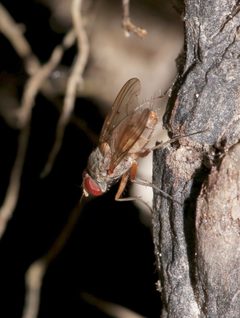
Eutrichota gopheri, commonly known as the gopher tortoise burrow fly, is a of root-maggot fly in the Anthomyiidae. The species was described by Johnson in 1913. Its reflects a documented association with gopher tortoise burrows, though specific details of this relationship remain limited in published literature. As a member of the Anthomyiidae, it belongs to a family whose larvae typically develop in soil, decaying organic matter, or plant roots.
Pronunciation
How to pronounce Eutrichota gopheri: /juːˈtrɪkə.tə ˈɡoʊfɛraɪ/
These audio files are automatically generated. While they are not always 100% accurate, they are a good starting point.
Identification
Identification to level requires examination of morphological characters, particularly male genitalia. The Eutrichota can be distinguished from related anthomyiid genera by combinations of bristle patterns on the and leg chaetotaxy. Definitive field identification is not possible without specimen collection and microscopic analysis.
Images
Habitat
Associated with gopher tortoise (Gopherus polyphemus) burrow systems in sandy, well-drained soils. Gopher tortoise burrows maintain stable temperature and humidity conditions and harbor diverse .
Distribution
Southeastern United States, within the range of the gopher tortoise (Gopherus polyphemus). Documented observations span Florida, Georgia, Alabama, Mississippi, and South Carolina.
Host Associations
- Gopherus polyphemus - burrow associateThe has been documented inhabiting gopher tortoise burrows; specific nature of the association (whether the fly uses burrow soil, organic matter, or tortoise for larval development) is not definitively established.
Similar Taxa
- Eutrichota sp.Other in the Eutrichota overlap geographically and share general ; species-level identification requires detailed examination of genitalia and bristle patterns.
- Anthomyiidae (family)Many anthomyiid flies are superficially similar small gray flies with reduced wing patterning; dissection and reference to specialized keys are necessary for and determination.
More Details
Nomenclatural note
The specific epithet 'gopheri' is a genitive noun referring to the gopher tortoise, indicating the ' type locality or primary association.
Data limitations
Published biological and ecological information for this is sparse. Most knowledge derives from collection records and iNaturalist observations rather than focused study. The larval and precise relationships remain undocumented in peer-reviewed literature.