
Chirosia betuleti
(Ringdahl, 1935)
Knotting Gall
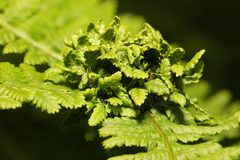
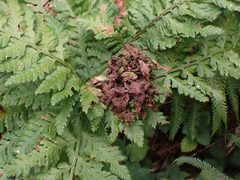
Chirosia betuleti is a gall-forming fly in the Anthomyiidae that induces characteristic knotting galls on fern fronds. The is best known through the distinctive damage it causes rather than . It has been recorded across much of Europe, with extensive documentation in the United Kingdom. The gall structure and larval mining are well-studied, though adult fly remains less documented.
Pronunciation
How to pronounce Chirosia betuleti: //kaɪˈɹoʊ.si.ə bɛˈtu.lɛ.taɪ//
These audio files are automatically generated. While they are not always 100% accurate, they are a good starting point.
Identification
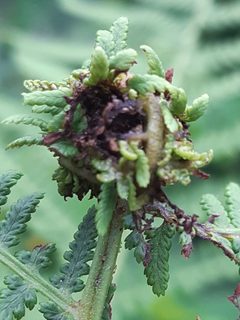
This is identified primarily by the gall it produces rather than fly . The knotting gall appears as a loose, mop- structure at the terminal shoot of fern fronds, with multiple pinnae involved in the coiled mass. An elongated white eggshell is typically visible at the center of the gall. The white larva mines along the rachis, feeding on trichomes and causing the frond tip to curl upward. Usually only one larva is present, occasionally two. Similar Chirosia species may form galls on different plants; confirmation requires rearing adults or molecular identification.
Images
Habitat
Associated with fern in woodland, hedgerow, and other shaded where ferns occur. The gall develops specifically in the terminal, unfurling fronds of host plants.
Distribution
Recorded throughout the United Kingdom including Cornwall, Wiltshire, Worcestershire, Hampshire, Norfolk, Warwickshire, Berkshire, Cardiganshire, Cheshire, Denbighshire, Suffolk, East Norfolk, Easterness, Elgin, Flintshire, North Ayrshire, Herefordshire, Merionethshire, Perth, Yorkshire, Montgomeryshire, Lincolnshire, Somerset, Oxfordshire, Shropshire, Devon, Stafford, Surrey, Gloucestershire, Kent, and Worcestershire. Also documented in the Netherlands, Czech Republic, Denmark, Finland, France, Germany, Italy, Norway, Poland, Russia (north and north-west), Slovakia, Spain, Sweden, and Belgium.
Seasonality
emerge in spring. are laid in unfurling fronds. Pupae drop from galls in autumn and overwinter, with adults emerging the following spring.
Diet
Larvae feed on trichomes in the groove of the fern rachis. Specific feeding habits are not documented.
Host Associations
- Dryopteris dilatata - gall broad buckler fern
- Dryopteris filix-mas - gall male fern
- Athyrium filix-femina - gall lady fern
- Matteuccia struthiopteris - gall ostrich fern
Life Cycle
are deposited in unfurling fern fronds. Larvae hatch and feed on trichomes along the rachis groove, inducing the frond to curl inward and form the characteristic gall. Larvae complete development within the gall. Pupae drop to the ground in autumn and overwinter through winter months. emerge in spring to complete the cycle. Galling rates vary; up to nine of thirteen fronds on a single plant have been observed galled.
Behavior
Larval mining causes mechanical deformation of fronds through trichome consumption. Pupae exit the gall and drop to the substrate for .
Ecological Role
Gall-former that modifies fern growth architecture. Serves as for including braconids (Aphaereta spp.) and eulophids (Dimmockia spp., Elachertus spp.).
Human Relevance
Of interest to botanists and entomologists studying plant-animal interactions and gall . No documented economic or agricultural significance.
Similar Taxa
- Other Chirosia speciesMay induce similar gall structures on different plants; requires rearing or molecular methods for definitive identification
More Details
Parasitoid complex
Documented include braconid wasps of Aphaereta and eulophid of genera Dimmockia and Elachertus.