
Homoneura philadelphica
(Macquart, 1844)
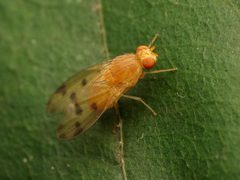
Homoneura philadelphica is a small fly in the Lauxaniidae, a group commonly known as lauxaniid flies. The is noted for its distinctive orange coloration, which has been observed in individuals attracted to decaying pumpkins. It is one of many species in the Homoneura, which contains numerous small, often colorful flies found in various across North America.
Pronunciation
How to pronounce Homoneura philadelphica: /ˌhoʊ.moʊˈnʊə.rə ˌfɪ.ləˈdɛf.ɪ.kə/
These audio files are automatically generated. While they are not always 100% accurate, they are a good starting point.
Identification
The orange coloration may help distinguish this from other small flies, though positive identification to species level requires examination of microscopic characters. Members of the Homoneura can be separated from similar small flies by features of the wing venation and chaetotaxy (bristle arrangement), though these require specialized knowledge and magnification. The Lauxaniidae is distinguished from other acalyptrate fly families by a combination of characters including a usually bare and specific wing venation patterns.
Images
Appearance
Small fly with distinctive orange coloration. Detailed morphological features are not well documented in available sources, though the Homoneura is characterized by small body size and often bright or patterned coloration.
Habitat
Has been observed in association with decaying organic matter, specifically fermenting pumpkins. The broader Homoneura is found in various including forests and wetlands.
Distribution
Documented from North America; specific range details are sparse. The type locality reference to "Philadelphica" suggests eastern North American origins, though the likely occurs more broadly.
Seasonality
Observed in autumn (late October), coinciding with the availability of decaying pumpkins and other fermenting vegetation.
Behavior
Attracted to decaying vegetable matter, particularly fermenting pumpkins. This is consistent with many lauxaniid flies that visit decaying organic material.
Ecological Role
Likely contributes to nutrient cycling through association with decaying organic matter. May serve as prey for larger insects, spiders, and other arthropods.
Human Relevance
Minimal direct impact. Occasionally noticed by naturalists and entomologists due to its bright coloration when visiting jack-o'-lanterns and other decaying vegetation.
Similar Taxa
- Other LauxaniidaeMany small flies in this share similar size and general body plan; microscopic examination required for definitive identification.
- Drosophilidae (pomace flies)Also attracted to fermenting fruit and decaying vegetation, though typically smaller and with different wing venation and structure.
- Other Homoneura speciesThe contains numerous that are difficult to distinguish without detailed examination of genitalia and other microscopic characters.
More Details
Observation context
The only detailed observation of this in the provided sources comes from a single blog post describing insects attracted to a jack-o'-lantern in South Deerfield, Massachusetts, on October 31, 2009. The author noted it as a 'favorite fly of the day' due to its pumpkin-orange coloration.