
Hirtodrosophila
Duda, 1923
Species Guides
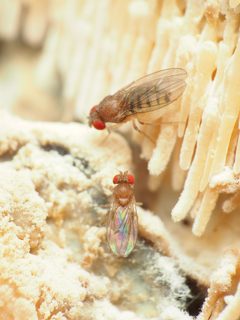
2Hirtodrosophila is a of fruit flies in the Drosophilidae, elevated from subgenus status within Drosophila by Grimaldi in 1990. The genus comprises approximately 150 described divided into ten species groups, with highest diversity in tropical and subtropical regions. Most species are mycophagous, with larvae feeding on fungi, though at least one species has evolved predatory on frog embryos. The genus belongs to the monophyletic Zygothrica genus group of mycophagous drosophilids, though Hirtodrosophila itself is .
Pronunciation
How to pronounce Hirtodrosophila: /hɜːrtəʊˈdrɒsəfɪlə/
These audio files are automatically generated. While they are not always 100% accurate, they are a good starting point.
Identification
Third antennal segment large with unusually long setae. with one branch. reclinate orbital bristle fine. Ventral receptacle in form of loops, folded flat against ventral surface of vagina. Some groups contain morphologically similar difficult to distinguish by external alone.
Images
Habitat
Primarily associated with fungal fruiting bodies in forested environments. Hirtodrosophila polypori occurs in Australian rainforest, where males display on bracket fungi. Hirtodrosophila hirticornis group collected around Auricularia spp. fruiting bodies.
Distribution
Worldwide distribution with concentration of in tropical and subtropical regions. Approximately 30 Neotropical species described, with additional undescribed species sampled across Brazilian regions. Records from Korea, Central America (Nicaragua), Australia, and Europe (Denmark, Norway, Sweden).
Diet
Larvae feed primarily on fungi. Hirtodrosophila batracida is predatory, with larvae feeding on embryos of the glass frog Centrolenella fleischmanni.
Life Cycle
stages described for Hirtodrosophila batracida; fine morphological features of larvae documented.
Behavior
Males of Hirtodrosophila polypori and related Australian exhibit : males aggregate on bracket fungi, defend fixed territories on upper fungal surfaces, and perform wing displays with aggressive male-male interactions. Females visit lek sites solely for mating; males provide no resources or .
Ecological Role
Mycophagous contribute to fungal decomposition and nutrient cycling. Predatory species (H. batracida) function as of amphibian embryos.
Sources and further reading
- BugGuide
- Wikipedia
- GBIF taxonomy match
- iNaturalist taxon
- NCBI Taxonomy
- Catalogue of Life
- Notes on the subgenus Hirtodrosophila (Diptera: Drosophilidae)
- Lek Behavior in Drosophila (Hirtodrosophila) Polypori Malloch-An Australian Rainforest Species
- Four new Neotropical species in the Hirtodrosophila hirticornis species group (Diptera: Drosophilidae)
- Lek behaviour in three species of the subgenus Hirtodrosophila of Australian Drosophila
- LEK BEHAVIOR IN DROSOPHILA (HIRTODROSOPHILA)POLYPORIMALLOCH-AN AUSTRALIAN RAINFOREST SPECIES
- Description and immature stages of Hirtodrosophila batracida sp. n. (Diptera: Drosophilidae), a predator of frog embryos
- The genome sequence of a drosophilid fruit fly, Hirtodrosophila cameraria (Haliday, 1833).