
Chelipoda
Macquart, 1823
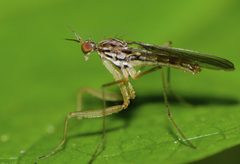
Chelipoda is a of dance flies in the Empididae, Hemerodromiinae. The genus exhibits profound , with males bearing exaggerated morphological characters whose structure-function relationships have been studied. A 2007 revision recognized 38 in New Zealand alone, including 22 newly described species. Phylogenetic analysis resolves two major clades distinguished by thoracic elongation, male genital flexion, -epandrium fusion, and cup shape.
Pronunciation
How to pronounce Chelipoda: //kɛˈlɪpoʊdə//
These audio files are automatically generated. While they are not always 100% accurate, they are a good starting point.
Identification
Members of Chelipoda can be distinguished from related by the presence of crossvein dm-cu in the wing; this is lost in Phyllodromia, which has been interpreted as homoplasious and of no generic significance. The genus is characterized by features including thoracic elongation and male genital structure, with two clades distinguished by degree of thoracic elongation, male genital flexion, fusion of with epandrial lobes, and shape of cup. Males exhibit exaggerated characters associated with profound .
Images
Distribution
New Zealand harbors significant diversity with 38 recorded . The has a broader distribution with one lineage hypothesized to represent Palaearctic and Nearctic forms, and another lineage showing a 'Gondwanan' distribution pattern. Distribution records include Denmark, Norway, and Sweden.
Similar Taxa
- PhyllodromiaLacks crossvein dm-cu, which is present in Chelipoda; previously considered potentially congeneric but dm-cu loss is interpreted as occurring independently in both Chelipoda lineages
- PtilophyllodromiaChelipoda-like with discussed relationships to Chelipoda
- MonodromiaChelipoda-like with discussed relationships to Chelipoda
More Details
Taxonomic revision
A comprehensive 2007 revision of New Zealand Chelipoda by Plant and Didham provided full descriptions and identification keys for all 38 , recognized 22 new species, and designated lectotypes for multiple Collin species. C. recurva Collin was synonymized with C. mirabilis Collin.
Sexual dimorphism
The shows a high of profound , with males possessing exaggerated morphological characters. Structure-function relationships of these male characters have been explicitly explored in the literature.
Phylogenetic hypotheses
Cladistic analysis supports two major clades whose divergence may reflect biogeographic history: one lineage associated with Palaearctic/Nearctic distributions and another with 'Gondwanan' distribution patterns.