
Plagioneurus
Loew, 1857
Species Guides
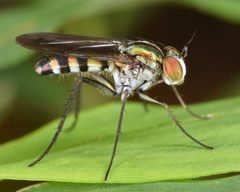
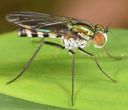
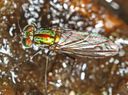
1Plagioneurus is a of long-legged flies ( Dolichopodidae) containing a single , Plagioneurus univittatus. It is the sole member of the Plagioneurinae. The genus is distinguished by an unusual wing venation pattern: the medial M converges obliquely with radial vein R4+5, a trait reflected in its etymology from Greek 'plágios' (oblique) and 'neûron' (nerve). display metallic green with a central black stripe and black with white bands.
Pronunciation
How to pronounce Plagioneurus: //ˌplædʒiəˈnʊərəs//
These audio files are automatically generated. While they are not always 100% accurate, they are a good starting point.
Identification
are recognized by the combination of metallic green with a strong central black stripe, black bearing white bands, and hyaline wings. The definitive diagnostic feature is the wing venation: the portion of medial M meets radial vein R4+5 at an oblique angle rather than running parallel or diverging. This venation pattern is unique among Dolichopodidae and gives the its name.
Images
Distribution
Eastern United States southward through the Neotropics to South America.
Similar Taxa
- Other Dolichopodidae generaPlagioneurus is distinguished from all other dolichopodid by its unique -level wing venation, specifically the oblique convergence of M with R4+5. Most Dolichopodidae have M running parallel to or diverging from R4+5.
More Details
Etymology
The name derives from Ancient Greek πλάγιος (plágios, 'oblique') and νεῦρον (neûron, 'nerve'), directly referencing the diagnostic oblique angle of the medial wing .
Taxonomic status
Plagioneurus is the only in the Plagioneurinae, making it phylogenetically isolated within Dolichopodidae. The single P. univittatus represents the entire generic and subfamilial diversity.