
Paraclius
Loew, 1864
Species Guides
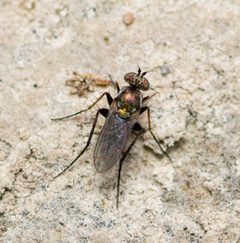
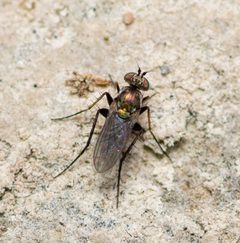
2Paraclius is a of long-legged flies in the Dolichopodidae, currently comprising approximately 140 worldwide. The genus is considered polyphyletic and is undergoing taxonomic revision, with several species recently synonymized or transferred to other genera. Species are distributed primarily in the Nearctic and Neotropical regions, with additional diversity in the Palearctic, particularly China. Paraclius species are predatory, with at least one species, P. curvispinus, documented as a of mosquito larvae.
Pronunciation
How to pronounce Paraclius: /ˈpærəkliəs/
These audio files are automatically generated. While they are not always 100% accurate, they are a good starting point.
Identification
of Paraclius can be distinguished by antennal , particularly the structure of the stylus. Some species possess a bi- -like stylus, a diagnostic feature used in recent taxonomic revisions. The P. arcuatus species-group includes species with distinctive wing venation and male genitalic structures; an identification key for this group has been published. Species-level identification requires examination of male terminalia and antennal characters.
Images
Distribution
Nearctic Region; Neotropical Region; Palearctic Region (China: Guizhou and Guangxi provinces, where P. curvispinus is ). Specific collection records include Brazil (Espírito Santo, Goiás, São Paulo states) and China (Huaping National Nature Reserve, Guilin, Guangxi).
Diet
Predatory. Paraclius curvispinus has been documented preying on mosquito larvae. General feeding habits for other in the are not established.
Behavior
Attracted to light traps, as documented for P. curvispinus in China. Predatory on mosquito larvae has been observed.
Ecological Role
Potential agent for mosquito . P. curvispinus has been identified as a natural enemy insect resource with possible applications in insect pest management.
Human Relevance
Investigated for potential use in of mosquitoes. No other documented human interactions.
Similar Taxa
- TachytrechusParaclius americanus was transferred from Tachytrechus; both share similar antennal and have been historically confused.
- PelastoneurusParaclius praedicans was moved to Pelastoneurus, indicating historical taxonomic overlap between these .
Sources and further reading
- BugGuide
- Wikipedia
- GBIF taxonomy match
- iNaturalist taxon
- NCBI Taxonomy
- Catalogue of Life
- Review of Paraclius arcuatus species-group (Diptera, Dolichopodidae) with description of two new species
- Species of Paraclius Loew (Diptera: Dolichopodidae) with bi-lamellate antennal stylus: new combination, new synonym, and two new species
- The complete mitochondrial genome of Paraclius curvispinus Yang et Saigusa, 2001 (Diptera: Dolichopodidae).