
Hercostomus
Loew, 1857
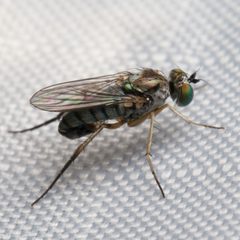
Hercostomus is a large of long-legged flies in the Dolichopodidae, containing more than 483 worldwide. Multiple studies have demonstrated that Hercostomus is polyphyletic, representing an artificial of species that do not share a single common ancestor. The genus includes numerous species groups, many of which are defined by morphological characters such as male genitalia structures and leg coloration. Species occur across diverse including mangroves in Southeast Asia, forests in the Palearctic region, and various environments in the Afrotropics.
Pronunciation
How to pronounce Hercostomus: /hɛrˈkɔstəməs/
These audio files are automatically generated. While they are not always 100% accurate, they are a good starting point.
Identification
Identification of Hercostomus relies heavily on male genitalia characters, particularly the structure of the and fore . Afrotropical species can be conditionally divided into subgroups based on projections on the male cercus: the H. nectarophagus subgroup has one ventral projection, while the H. perturbus subgroup has two. Palearctic species have been traditionally grouped by coloration, postocular setae color, and coloration. The subgenus Gymnopternus can be distinguished by morphological attributes that cluster separately from other Hercostomus species in phenetic analyses.
Images
Habitat
have been documented in mangrove in Thailand and Singapore, with H. brevicornis, H. brevidigitalis, H. lanceolatus, and H. plumatus specifically recorded from these environments. The subgenus Gymnopternus in western Europe shows distinct habitat preferences among species. Specific microhabitat associations have been investigated for H. plagiatus in central and southern Europe.
Distribution
distribution with records from: China (including Inner Mongolia and at least 25 groups), Thailand, Singapore, Kenya, Namibia, Tanzania, South Africa, central and southern Europe, western Europe (Denmark, Norway, Sweden), and across the Palearctic, Afrotropical, and Oriental biogeographic regions.
Seasonality
Seasonal activity patterns have been documented for in the subgenus Gymnopternus in western Europe, where phenological differences contribute to separation among sympatric species. H. plagiatus in central and southern Europe has been investigated for and sex ratios.
Similar Taxa
- AfrohercostomusFormerly Hercostomus Group I (Afrotropical); separated based on morphological characters and phylogenetic distinctness
- NeohercostomusFormerly Hercostomus Group III (Afrotropical); elevated to status based on phylogenetic studies showing it is not closely related to Hercostomus sensu stricto
More Details
Polyphyly
Multiple independent studies have confirmed that Hercostomus as currently defined is polyphyletic, meaning it comprises from multiple evolutionary lineages rather than a single . This has led to the reclassification of some groups into separate (Afrohercostomus, Neohercostomus) and suggests further taxonomic revision is needed.
Species Groups
The contains numerous informal groups, many defined by geographic region and morphological similarity rather than confirmed phylogenetic relationships. At least 25 species groups are known from China alone, and five numbered groups are traditionally recognized in the Palearctic based on coloration characters.
Taxonomic Complexity
The large number of (483+) and the polyphyletic nature of the make identification challenging. Cryptic species exist, as demonstrated by the splitting of H. plagiatus into two distinct species (H. plagiatus and H. verbekei) based on combined morphological and ecological evidence.
Sources and further reading
- BugGuide
- Wikipedia
- GBIF taxonomy match
- iNaturalist taxon
- NCBI Taxonomy
- Catalogue of Life
- Morphological and ecological characterization of Hercostomus (Hercostomus) plagiatus and a sibling species, H. verbekei sp.n. (Diptera: Dolichopodidae)
- New species and records of the genus Hercostomus Loew (Diptera: Dolichopodidae) from Thailand mangroves, with notes on the Hercostomus fauna of Singapore mangroves
- New species of Hercostomus Loew, 1857 from Afrotropics (Diptera: Dolichopodidae) and key to Afrotropical fauna
- Phenetic and ecological relationships between species of the subgenus Hercostomus (Gymnopternus) in western Europe with the description of two new species (Diptera: Dolichopodidae)
- The genus Hercostomus Loew (Diptera, Dolichopodidae, Dolichopodinae) from Inner Mongolia, China, with the description of two new species.