
Sphyracephala
Say, 1828
Hammerhead Flies, Stalk-eyed Flies
Species Guides
2- Sphyracephala brevicornis(short-horned ankle-headed fly)
- Sphyracephala subbifasciata
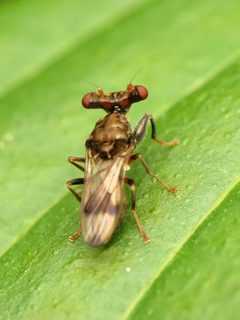
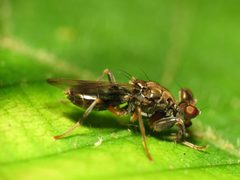
Sphyracephala is a of stalk-eyed flies (Diopsidae) distributed across Africa, Europe, Asia, and North America. exhibit weak to moderate in stalk length. Eye span serves as an honest signal of fighting capacity and resource-holding potential in both sexes. The genus includes nine recognized species, with some showing remarkable clustering in exceeding 100,000 individuals.
Pronunciation
How to pronounce Sphyracephala: /ˌsfɪrəsəˈfɑːlə/
These audio files are automatically generated. While they are not always 100% accurate, they are a good starting point.
Identification
Members of this possess short, stout stalks compared to the more elongated stalks of related genera like Cyrtodiopsis. Extensive tissue in the eye stalks stores lipids and , visible upon dissection. in eye span varies among , with some and others dimorphic. Resembles the extinct Baltic amber genus Prosphyracephala.
Images
Habitat
Commonly found on leaves and stems of trees and plants along streams and rivers.
Distribution
Afrotropical Region (S. beccarii, S. munroi), Palaearctic Region (S. babadjanidesi in Balkan and Caucasus Regions, S. nigrimana in Far Eastern Russia and North-Eastern China, S. beccarii marginally), and Nearctic Region (S. brevicornis, S. subbifasciata). Four Holarctic reach northern distributional limits between 45°30'N and 48°20'N.
Seasonality
Active in spring and autumn with characteristic clustering during these periods. Hibernation occurs during winter months.
Life Cycle
Larval nutritional conditions influence stalk development. Adults emerge with fully developed eye stalks that cannot change size due to the hardened .
Behavior
Forms very large clusters numbering over 100,000 individuals, with roughly equal sex ratios in . Engages in ritualized contests where individuals with longer spans win regardless of sex combination (male-male, female-female, male-female). When contestants have similar eye spans (difference less than 10%), contests do not end quickly and energy availability influences outcomes. Males show tendency to persist in contests when eye span differences are small.
Similar Taxa
- CyrtodiopsisBoth are stalk-eyed flies in Diopsidae, but Cyrtodiopsis possess thin, long stalks with minimal , whereas Sphyracephala has short, stout eye stalks with extensive energy-storing fat body tissue.
- ProsphyracephalaExtinct known from Baltic amber that resembles Sphyracephala in overall .
More Details
Sex Ratio Variation
Sex ratios vary among and : S. beccarii shows balanced sex ratios in Continental Africa and the Arabian Peninsula but a female-biased 2:1 ratio in Madagascar, representing the first documented case of female-biased sex ratio in a geographically isolated population of a diopsid.
Allometric Patterns
Allometric slopes for span relate to four subtaxa within two groups. Both sexual monomorphism and dimorphism occur across the .
Taxonomic History
S. europaea Papp & Földvári has been synonymized with S. babadjanidesi Zaitzev based on geometric morphometric analysis.
Sources and further reading
- BugGuide
- Wikipedia
- GBIF taxonomy match
- iNaturalist taxon
- NCBI Taxonomy
- Catalogue of Life
- A revision of the four Afrotropical and Palaearctic Sphyracephala Say (Diptera, Diopsidae) with an illustrated overview of the other five Sphyracephala
- Author Correction: Handicap theory is applied to females but not males in relation to mate choice in the stalk-eyed fly Sphyracephala detrahens.
- Differences in energy source storage in eye stalks between two species of stalk-eyed flies, Sphyracephala detrahens and Cyrtodiopsis dalmanni.
- Handicap theory is applied to females but not males in relation to mate choice in the stalk-eyed fly Sphyracephala detrahens.