
Diopsidae
Stalk-eyed Flies
Genus Guides
1- Sphyracephala(Hammerhead Flies)
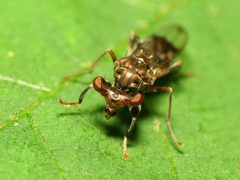
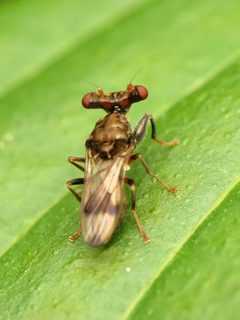
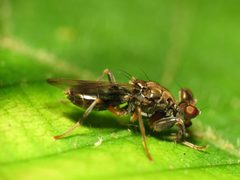
Stalk-eyed flies are a of true flies distinguished by their most conspicuous feature: mounted at the ends of long lateral projections called eyestalks. This unique is directly linked to their mating , with males typically possessing longer eyestalks than females and using them in visual displays during courtship. The family occurs primarily in tropical and subtropical regions of Africa and Asia, with some extending into the Arabian Peninsula and other areas. Several species are known agricultural pests, particularly as stem-borers in rice and other Poaceae.
Pronunciation
How to pronounce Diopsidae: /daɪˈɒpsɪdiː/
These audio files are automatically generated. While they are not always 100% accurate, they are a good starting point.
Identification
are immediately recognizable by their eyestalks—lateral projections from the with the at their ends. The arise from the eyestalks themselves, not from the central head capsule; this distinguishes them from other stalk-eyed flies in such as Drosophilidae, Platystomatidae, Richardiidae, and Tephritidae, which have centrally positioned antennae. Males typically exhibit longer eyestalks than females, and eyestalk length varies considerably among .
Images
Habitat
occur in diverse from lowland to upland areas, including rain forests, forest edges, and agricultural fields. Some species are found on low shrubs and herbaceous vegetation; there is indication that others may occur in tree . Specific microhabitats include the spathes of aroid flowers for some African species, and rice fields and other Poaceae stands for pest species.
Distribution
Primarily Afrotropical and Oriental regions, with greatest diversity in Africa and Southeast Asia. Records exist from the Arabian Peninsula (Oman, Saudi Arabia, Yemen), South Africa to Egypt, Kenya, Tanzania, Uganda, Burundi, Angola, Malawi, Indonesia, and Malaysia. Some have exceptionally wide distributions (e.g., Diopsis mayae from South Africa to Saudi Arabia), though most have restricted, ranges.
Diet
Larvae of some are secondary stem-borers in rice and other Poaceae. feeding habits are not well documented in available sources.
Life Cycle
For Cyrtodiopsis whitei, the has been described in detail, though specifics vary among . Larval development occurs within plant stems for stem-boring species.
Behavior
Mating is optically triggered and mediated by eyestalk ; males use their eyestalks in visual displays during courtship. Some form large or clusters, with one observation documenting over 80,000 Sphyracephala beccarii in a single cluster in Oman. Activity patterns appear consistent across morning, midday, and afternoon periods based on limited observational data.
Ecological Role
Some function as agricultural pests, particularly in rice . The serves as for various parasitic organisms including (Trichogrammatidae) and Laboulbeniales fungi (Rhizomyces spp.), which may provide natural . Stalk-eyed flies are also subject to by bacteria, which can affect reproductive .
Human Relevance
Several are significant agricultural pests as stem-borers in rice and related crops, causing economic damage in affected regions. The has been extensively studied in evolutionary and behavioral due to the dramatic in eyestalk length and its role in .
Similar Taxa
- Platystomatidae (signal flies)Some have laterally projecting , but arise from the central capsule, not from the eyestalks.
- RichardiiidaeSome exhibit stalk-eyed , but differ in antennal placement and other structures.
- Tephritidae (fruit flies)Certain have projections, but are centrally positioned and wing patterns typically differ.
- DrosophilidaeSome show stalks, but antennal placement and overall body form differ from .
Sources and further reading
- BugGuide
- GBIF taxonomy match
- iNaturalist taxon
- NCBI Taxonomy
- Catalogue of Life
- diopsidae_.jpg | Entomology Research Museum
- Bug Spotlight | Entomology Research Museum
- Host and a Parasite: Battle of Sand Field Crickets vs. Horsehair Worms | Bug Squad
- New Bug Blogs of note | Beetles In The Bush
- Desert-Dwelling Entomologists Visit the Rainforest in Belize
- The occurrence of stalk-eyed flies (Diptera, Diopsidae) in the Arabian Peninsula, with a review of cluster formation in the Diopsidae
- Egg Parasitoids (Hymenoptera; Trichogrammatidae) of Diopsis Macrophthalma (Diptera; Diopsidae) in Malawi
- Physiological, Behavioural, and Morphometric Data Elucidate the Evolutive Significance of Stalked Eyes in Diopsidae (Diptera)
- New species of Rhizomyces (Ascomycota, Laboulbeniales) parasitic on African stalk-eyed flies (Diptera, Diopsidae)
- Jenis dan habitat “lalat mata bertangkai” (Diptera: Diopsidae) di bogor
- A revision of Centrioncus Speiser (Diptera, Diopsidae, Centrioncinae) with descriptions of new species from Angola, Burundi, and Kenya
- Diopsis mayae sp. n. (Diptera, Diopsidae), a dominant stalk-eyed fly, occurring from South Africa to Saudi Arabia
- Distribution and reproductive effectsof Wolbachia in stalk-eyed flies(Diptera: Diopsidae)
- Distribution and reproductive effectsof Wolbachia in stalk-eyed flies (Diptera: Diopsidae)
- A revision of the four Afrotropical and Palaearctic Sphyracephala Say (Diptera, Diopsidae) with an illustrated overview of the other five Sphyracephala.