
Wyeomyia vanduzeei
Dyar & Knab, 1906
Bromeliad Mosquito
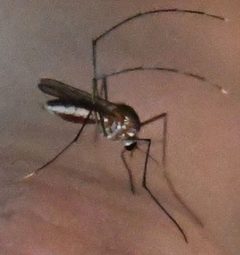
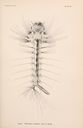
Wyeomyia vanduzeei is a mosquito in the Culicidae, first described by Dyar and Knab in 1906. It is commonly known as the bromeliad mosquito, reflecting its association with bromeliad plants. The species has been demonstrated experimentally to serve as a for Plasmodium hermani, a of wild turkeys. Its distribution includes the Caribbean and North America.
Pronunciation
How to pronounce Wyeomyia vanduzeei: //waɪ.iˈoʊmiə vændʌˈzi.i//
These audio files are automatically generated. While they are not always 100% accurate, they are a good starting point.
Images
Habitat
Associated with bromeliad plants, which serve as larval development sites. The "bromeliad mosquito" indicates this specialized ecological relationship.
Distribution
Recorded from the Caribbean and North America based on GBIF distribution records.
Host Associations
- Wild turkey (Meleagris gallopavo) - of associated Experimental studies demonstrate W. vanduzeei can transmit Plasmodium hermani, a of wild turkeys
- Plasmodium hermani - (experimental) ; W. vanduzeei shown to be susceptible to under laboratory conditions
- Bromeliad plants - /larval development siteImplied by ; typical of Wyeomyia
Life Cycle
Typical of mosquitoes: , larva, pupa, . Larval development occurs in water-holding structures of bromeliad plants.
Human Relevance
Research interest as experimental for . No documented significance as human vector.
More Details
Experimental vector status
Laboratory studies have established W. vanduzeei as a competent experimental for Plasmodium hermani, contributing to understanding of transmission dynamics. This does not necessarily indicate natural competence in wild .
Sources and further reading
- BugGuide
- Wikipedia
- GBIF taxonomy match
- iNaturalist taxon
- NCBI Taxonomy
- Catalogue of Life
- Bembicid Holdings | Entomology Research Museum
- When Mosquitoes Go to Bed for Winter, and How It Can Inform Management
- Rosaceae | Beetles In The Bush | Page 2
- April | 2010 | Beetles In The Bush | Page 2
- Nevada | Beetles In The Bush | Page 3
- Wyeomyia vanduzeei, an Experimental Host for Wild Turkey Malaria Plasmodium hermani