
Culex salinarius
Coquillett, 1904
Unbanded Saltmarsh Mosquito
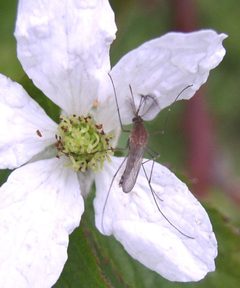
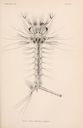
Culex salinarius, commonly known as the unbanded saltmarsh mosquito, is a North American mosquito found in coastal and salt marsh . Larvae develop in saline or brackish water environments, distinguishing it from many freshwater-breeding Culex species. are active seasonally, with influenced by coastal conditions. The species serves as a for microsporidian including Amblyospora sp., which are transmitted transovarially to offspring.
Pronunciation
How to pronounce Culex salinarius: //ˈkjuː.lɛks ˌsæl.ɪˈnɛər.i.əs//
These audio files are automatically generated. While they are not always 100% accurate, they are a good starting point.
Images
Habitat
Salt marsh environments serve as primary larval , particularly in coastal zones. Larval development occurs in saline or brackish water pools within marsh systems.
Distribution
Coastal New York; southeastern Texas upper coastal zone; distributed across Caribbean, Middle America, and North America according to GBIF records.
Seasonality
Seasonal activity patterns documented in southeastern Texas upper coastal zone; has been investigated indicating survive winter months.
Life Cycle
Larval stage develops in salt marsh water pools. of microsporidian Amblyospora sp. to progeny occurs through infected females. Parasite sporulation and ovarian development in females are synchronized and initiated by blood feeding.
Behavior
documented; exhibit seasonal activity variations.
Ecological Role
Serves as for microsporidian (Amblyospora sp.), contributing to parasite completion and potentially influencing through transovarial .
Sources and further reading
- BugGuide
- Wikipedia
- GBIF taxonomy match
- iNaturalist taxon
- NCBI Taxonomy
- Catalogue of Life
- Are Culex Mosquitoes Potential Vectors of the Zika Virus? | Bug Squad
- Breaking News: Zika Virus Found in Wild-Caught Culex | Bug Squad
- Megan Meuti's Way of Tricking Mosquitoes Into Not Biting You | Bug Squad
- Unique Egg-Laying Behavior Re-Discovered in Culex Mosquito Species
- Bloodsuckers in the basement: Subterranean mosquito, Culex pipiens form molestus — Bug of the Week
- There will be blood: Northern House Mosquito, Culex pipiens, and friends — Bug of the Week
- Salt Marsh as Culex salinarius Larval Habitat in Coastal New York
- A Preliminary Study of the Seasonal Geographic Distribution and Overwintering of Culex Restuans Theobald and Culex Salinarius Coquillet (Diptera: Culicidae)
- Life cycle and epidemiology of Amblyospora sp. (Microspora: Thelohaniidae) in the mosquito Culex salinarius Coquillett / by Theodore George Andreadis.
- Sporulation of Amblyospora (Microspora) in female Culex salinarius: induction by 20-hydroxyecdysone
- SEASONAL VARIATIONS IN ACTIVITY AND SIZE OF ADULT FEMALES AND LOCAL DISTRIBUTION OF LARVAE FOR POPULATIONS OF CULEX SALINARIUS IN THE UPPER COASTAL ZONE OF SOUTHEASTERN TEXAS1