
Anopheles franciscanus
McCracken, 1904
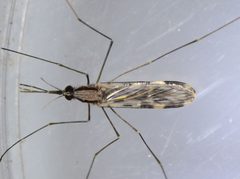
Anopheles franciscanus is a mosquito in the Culicidae, first described by McCracken in 1904. The species has been documented in southern California and is part of the Anopheles , which includes mosquitoes capable of transmitting . Seven have been described, ranging across Middle America and North America.
Pronunciation
How to pronounce Anopheles franciscanus: /əˈnɒfɪliːz frænˈsɪkənəs/
These audio files are automatically generated. While they are not always 100% accurate, they are a good starting point.
Identification
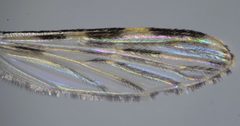
Specific morphological features distinguishing Anopheles franciscanus from other Anopheles are not documented in available sources. As with other Anopheles mosquitoes, likely exhibit the characteristic resting posture with body angled away from the surface and , palps, and aligned forward.
Images
Habitat
Collected in southern California; specific preferences are not documented.
Distribution
Documented from southern California. GBIF records indicate presence in Middle America and North America.
Human Relevance
As a member of the Anopheles , this may have potential significance for public health given that some Anopheles mosquitoes are of Plasmodium that cause . However, specific vector status for Anopheles franciscanus is not documented in available sources.
Similar Taxa
- Other Anopheles speciesAnopheles franciscanus shares -level characteristics with other Anopheles mosquitoes, including similar body plan and resting posture. Specific distinguishing features from are not documented.
More Details
Subspecies
Seven have been described: Anopheles franciscanus bifoliata (Osorno-m. & Munoz-s., 1948), Anopheles franciscanus franciscanus (McCracken, 1904), Anopheles franciscanus levicastilloi (Levi-castillo, 1944), Anopheles franciscanus neghmei (Mann, 1950), Anopheles franciscanus noei (Mann, 1950), Anopheles franciscanus patersoni (Alvarado & Heredia, 1947), and Anopheles franciscanus rivadeneirai (Levi-castillo, 1945).
Taxonomic Status
Catalogue of Life lists this as a synonym, while GBIF treats it as accepted. This discrepancy indicates some taxonomic uncertainty that may require further investigation.
Sources and further reading
- BugGuide
- Wikipedia
- GBIF taxonomy match
- iNaturalist taxon
- NCBI Taxonomy
- Catalogue of Life
- The Amazing Bee-Parasite Research of Leslie Saul-Gershenz | Bug Squad
- Those Incredible Digger Bees and Their Nest Parasites | Bug Squad
- A Silver Digger Bee in Flight at Bodega Head | Bug Squad
- Why Silver Digger Bees Are Like Gold | Bug Squad
- Anopheles Mosquitoes as Vectors of Malaria in East Africa: Bed Nets and Beyond
- How One State's Mosquito Data Could Reduce Risk of Malaria Returning to U.S.