
Orthocladius
Wulp, 1874
Orthocladius is a of non-biting midges in the Chironomidae. Larvae are aquatic and construct silk tubes that serve as microhabitats for associated microbial . The genus includes adapted to diverse freshwater environments, including streams and hygropetric .
Pronunciation
How to pronounce Orthocladius: /ɔrˈθoʊklædiəs/
These audio files are automatically generated. While they are not always 100% accurate, they are a good starting point.
Identification
-level identification relies heavily on pupal characters; male genitalia and larval characters are also used but require separate examination. West Palaearctic species can be distinguished using published keys to pupal exuviae. Some species pairs (e.g., O. pedestris and O. obumbratus) require careful comparison of subtle morphological differences.
Images
Appearance
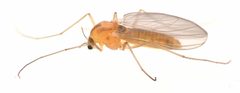
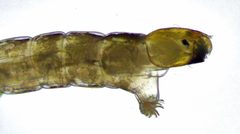
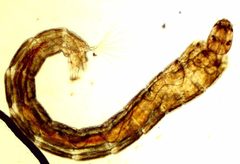
Non-biting midges with slender bodies typical of Chironomidae. Larvae construct silk tubes with filamentous substructure repeating at 50-nm intervals. Pupal bear diagnostic characters used for identification, though specific morphological details vary among species.
Habitat
Freshwater aquatic environments. Larvae occur in streams and rivers, with some occupying hygropetric (moist rocky surfaces with thin water films). Tube-building larvae attach to submerged substrates in flowing water.
Distribution
West Palaearctic region (including Italy), arctic Alaska, and other northern temperate regions. Distribution varies by ; some have restricted ranges while others are more widespread.
Diet
Larvae graze on periphyton and diatoms. Orthocladius rivulorum has been observed feeding specifically on the diatom Hannaea arcus growing on tube exteriors.
Life Cycle
Holometabolous with , larval, pupal, and stages. Larvae construct silk tubes that persist through development; pupal tubes contain less algal than larval tubes, suggesting larval activity enhances algal growth on tubes.
Behavior
Larvae build silk tubes that function as microcommunities, supporting attached diatoms and bacteria. These microcommunities exhibit trophic independence from surrounding epilithon. Larval grazing activity appears to promote algal accumulation on tubes.
Ecological Role
Stream grazer that responds directly and indirectly to nutrient regimes. Orthocladius tubes can constitute 12–43% of total epilithic algal and serve as favorable for diatoms compared to rocks or artificial substrates. The tube microcommunities function with considerable independence from surrounding portions of the epilithon.
Similar Taxa
- Other Orthocladiinae generaShare characteristics but differ in pupal and larval tube-building ; Orthocladius is distinguished by specific pupal characters detailed in taxonomic keys.
- Other Chironomidae generaNon-biting midges in other lack the specific pupal characters and tube-building larval characteristic of Orthocladius.
More Details
Nutrient response
Orthocladius microcommunities show enhanced microbial activity and under phosphorus enrichment, with additive effects from nitrogen. Larvae grow larger in nutrient-enriched stream sections, benefiting from enhanced tube flora. This demonstrates primary phosphorus limitation and secondary nitrogen limitation in some stream systems.
Taxonomic complexity
The includes multiple subgenera (e.g., Orthocladius s. str., Eudactylocladius) with ongoing taxonomic revision. boundaries have been clarified through pupal analysis, with some previously synonymized species restored to valid status.
Sources and further reading
- BugGuide
- Wikipedia
- iNaturalist taxon
- NCBI Taxonomy
- Catalogue of Life
- Nutrient Incluence on a Stream Grazer: Orthocladius Microcommunities Respond to Nutrient Input
- Description of the pupal exuviae of some species belonging to Orthocladius s. str. van der Wulp, 1874 (Diptera: Chironomidae: Orthocladiinae), with a new key to species of West Palaearctic region
- The taxonomy and ecology ofOrthocladius (Eudactylocladius) fuscimanus(Kieffer), a hygropetric chironomid (Diptera)