
Clunio
Haliday, 1855
Species Guides
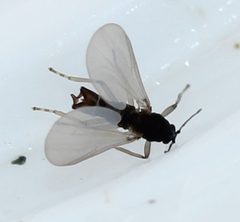
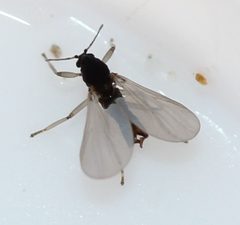
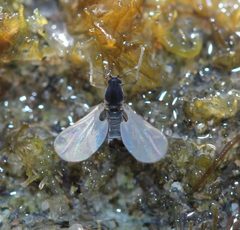
1Clunio is a of marine non-biting midges (Chironomidae: Orthocladiinae) restricted to the intertidal zone of coasts worldwide. All in the genus are exclusively marine, inhabiting rocky shores and hard substrates. The genus includes approximately 20 described species, with Clunio marinus serving as a major model system for chronobiology research due to its precisely timed lunar and semilunar reproductive rhythms synchronized to tidal cycles.
Pronunciation
How to pronounce Clunio: //ˈkluːni.oʊ//
These audio files are automatically generated. While they are not always 100% accurate, they are a good starting point.
Images
Habitat
Exclusively marine; restricted to the intertidal zone of rocky coasts and hard substrates. Larvae inhabit the midlittoral zone, often associated with calcareous substrates, coral , and algal bio-constructions such as Lithophyllum byssoides pavements. Found from the lower midlittoral to shallow sublittoral zones (down to approximately 20 m depth), typically beneath jetties or in areas with marine fouling communities.
Distribution
Worldwide distribution along temperate and tropical sea coasts. Documented from the Atlantic coasts of Europe (including Norway, France, Bulgaria), the Mediterranean Sea, the Black Sea, the Red Sea (Egypt), the Pacific coast of Mexico (Islas Marietas), and the Tyrrhenian Sea (Corsica). facilitated by hitchhiking on sea turtle and potentially via ship fouling.
Seasonality
Reproductive activity synchronized to lunar and semilunar cycles (14.77-day semilunar or 29.53-day lunar periods). timed to specific tidal windows, particularly spring low tides around full and new moon when the midlittoral zone becomes widely exposed. Timing varies by and ; some species show temperature-dependent emergence rhythms.
Diet
Larvae consume particulate organic matter.
Life Cycle
Holometabolous development with larval, pupal, and stages. Larvae are the long-lived stage, foraging in the marine environment. Adults are extremely short-lived, with females typically wingless and males fully winged. timed to precise tidal windows; males locate female pupae floating on the water surface, free them from pupal skins, and carry females to oviposition sites.
Behavior
Exhibits circalunar and circasemilunar synchronized by moonlight intensity, duration, and timing. Strain-specific sensitivity to moonlight cues allows precise entrainment to local tidal regimes. Some demonstrate allochronic divergence in reproductive timing, potentially driven by competition and -dependent .
Ecological Role
Important consumers of particulate organic matter in marine intertidal . Serve as prey for fish, insects, and birds. Some function as biological indicators of marine coastal quality, particularly for bio-constructions of the red calcified Lithophyllum byssoides.
Human Relevance
Clunio marinus is a long-standing model organism in chronobiology research, with its sequenced. Used to study circalunar clock mechanisms, tidal synchronization, and speciation processes. Some serve as bioindicators for monitoring marine coastal quality and climate change effects, including rising sea levels.
Sources and further reading
- BugGuide
- Wikipedia
- GBIF taxonomy match
- iNaturalist taxon
- NCBI Taxonomy
- Catalogue of Life
- The genus Clunio Haliday, 1855 from Egypt (Hurghada, Red Sea) with a description of the larva of Clunio sp.1 (Diptera, Chironomidae, Orthocladiinae)
- Primer registro del género Clunio (Diptera: Chironomidae) asociado a las comunidades coralinas de islas Marietas, México First record of the genus Clunio (Diptera: Chironomidae) associated with the coral communities at Islas Marietas, Mexico
- The Timing of Reproduction to Distinct Spring Tide Situations in the Intertidal Insect Clunio
- How light at night sets the circalunar clock in the marine midge Clunio marinus
- Can DNA barcoding be used to identify closely related Clunio Haliday, 1855 species (Diptera: Chironomidae, Orthocladiinae)?
- Time Cues for Semilunar Reproduction Rhythms in European Populations of Clunio Marinus. I. The Influence of Tidal Cycles of Mechanical Disturbance
- Description of the adult and larva of Clunio balticus Heimbach, 1978 (Diptera, Chironomidae) from the seashore of Bergen (Norway)
- TIME CUES FOR SEMILUNAR REPRODUCTION RHYTHMS IN EUROPEAN POPULATIONS OFCLUNIO MARINUS. II. THE INFLUENCE OF TIDAL TEMPERATURE CYCLES
- Clunio boudouresquei sp. n. and Thalassosmittia ballestai sp. n., two Tyrrhenian marine species occurring in Scandola Nature Reserve, West Corsica (Diptera: Chironomidae)
- How competition can drive allochronic divergence: a case study in the marine midge, Clunio marinus
- Description of the adult and immature stages of Clunio ponticus Michailova, 1980 (Diptera, Chironomidae), from the Black Sea, Varna, Bulgaria
- How Light at Night Sets the Circalunar Clock in the Marine Midge Clunio marinus
- Developmental and sexual divergence in the olfactory system of the marine insect Clunio marinus
- How competition can drive allochronic divergence: A case study in the Marine Midge, Clunio marinus