
Hippelatini
Enderlein, 1936
Genus Guides
2- Hippelates(eye gnats)
- Liohippelates(Liohippelates Eye Gnats)
Hippelatini is a tribe of small flies within the Chloropidae (frit flies or grass flies), Oscinellinae. Members are generally small, delicate dipterans associated with grassy or herbaceous . The tribe was established by Enderlein in 1936. Hippelatini includes such as Hippelates, which contains sometimes referred to as eye gnats due to their attraction to secretions.
Pronunciation
How to pronounce Hippelatini: //hɪˌpɛləˈtiːnaɪ//
These audio files are automatically generated. While they are not always 100% accurate, they are a good starting point.
Identification
Distinguished from other Chloropidae tribes by genitalic characters and chaetotaxy (bristle arrangement), requiring microscopic examination. Within Oscinellinae, Hippelatini can be separated from Oscinellini by features of the male terminalia and larval associations. The Hippelates, included in this tribe, is recognized by its small size, yellowish coloration, and of hovering near vertebrate .
Images
Appearance
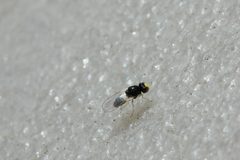
Small, delicate flies with body length usually 1–4 mm. Generally yellowish to grayish in coloration with reduced wing venation characteristic of Chloropidae. Many have distinctive dark markings on the or . short with bare or pubescent. Wings typically clear or faintly tinged, with reduced crossveins.
Habitat
Associated with grassy and herbaceous vegetation, including meadows, pastures, agricultural fields, and disturbed open . Larval stages develop in soil, decaying vegetation, or roots of grasses and sedges. Some occur in semi-aquatic or moist soil environments.
Distribution
Widespread in temperate and tropical regions. Well-represented in the Nearctic, Neotropical, and Palearctic regions. The Hippelates is particularly diverse in the Americas.
Seasonality
activity generally peaks during warm months, with timing varying by latitude. In temperate regions, most active from late spring through early autumn. Some tropical may be active year-round.
Life Cycle
Complete with , larval, pupal, and stages. Larvae are typically soil-dwelling or associated with plant roots and decaying organic matter. Specific developmental details vary by and .
Behavior
of some , particularly in the Hippelates, exhibit distinctive hovering around vertebrate and other moist body surfaces, attracted by secretions. This behavior has earned them the 'eye gnats.' They are not known to bite but can be persistent nuisances.
Ecological Role
Larvae contribute to soil nutrient cycling through feeding on decaying plant matter and root-associated microorganisms. Some may have minor roles as decomposers. serve as prey for small including spiders and other insects.
Human Relevance
Some Hippelates are nuisance pests due to their attraction to secretions, potentially contributing to transmission of bacterial conjunctivitis and other eye through mechanical transfer. They are not biting flies but can be economically significant as pests in agricultural and recreational settings. The tribe has limited direct agricultural impact compared to some other Chloropidae.
Similar Taxa
- OscinelliniAnother tribe in Oscinellinae; distinguished by genitalic and larval preferences, with Oscinellini often associated with different plants.
- ChloropiniTribe in Chloropinae; generally larger with different wing venation and larval habits, many being stem borers or leaf miners rather than soil dwellers.
More Details
Taxonomic history
The tribe Hippelatini was established by Enderlein in 1936 and has undergone various revisions in circumscription. Modern classifications place it within Oscinellinae based on molecular and morphological data. The Hippelates, type genus of the tribe, has been subject to extensive study due to its medical and veterinary significance.
Research significance
of Hippelates have been studied for their role in transmission, particularly in tropical and subtropical regions where they are abundant. Research has focused on their , , and control methods.