
Canacidae
beach flies, surf flies, surge flies
Subfamily Guides
3- Canacinae(surf flies)
- Pelomyiinae
- Tethininae(Beach Flies)
is a of minute Diptera commonly known as beach flies, surf flies, or surge flies. The family comprises approximately 307 in 27 as of 2010, though counts vary among sources. Following McAlpine's 2007 taxonomic revision, the family now includes Tethininae as a , uniting what were previously treated as separate families. Members are predominantly intertidal found along sea coasts worldwide.
Pronunciation
How to pronounce Canacidae: //kəˈnæsɪˌdiː//
These audio files are automatically generated. While they are not always 100% accurate, they are a good starting point.
Identification
Distinguished from similar small coastal Diptera by the combination of: large with small and prominent ; large oval mouth opening; three to four pairs of outward-directed orbital bristles; absence of postvertical bristles with presence of diverging pseudopostocellar bristles; wing with subcostal break where subcosta parallels and merges with R1; and tibiae lacking preapical bristle. The unmarked wings and grey-brown to yellow body coloration separate them from many other minute shore-dwelling flies. Tethininae (now ) can be distinguished from Canacinae by subtle chaetotactic differences and male terminalia structure requiring microscopic examination.
Images
Appearance
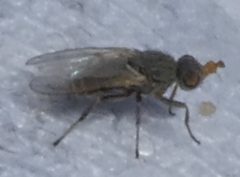
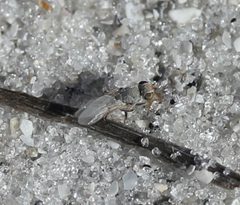
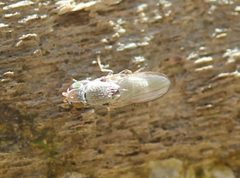
Minute flies ranging 1.6–5 mm in length. Body coloration yellow, grey, or grey-brown with (powdery) coating and whitish to greyish markings. disproportionately large with small bearing bare to pubescent . Mouth opening large and oval. Three or four pairs of orbital bristles directed outward (inset upswept). Postvertical bristles absent; diverging pseudopostocellar bristles present. Additional head bristles include ocellar bristles, 2–5 pairs of frontal bristles curving outward, interfrontal bristles, and vibrissae. Genae high with one or more upcurving bristles. Wings unmarked in nearly all . with subcostal break; subcosta parallels R1 and merges with it just before the costa. Tibiae lack preapical bristle.
Habitat
Strictly intertidal zone along sea coasts. Found on surfaces of small water bodies, both saline and fresh, in locations protected from wind. Rocky shore appear essential for many ; absence of such habitats correlates with absence of surf flies (e.g., Rodrigues Island). Some occur in subantarctic regions including the Kerguelen Biogeographical Province.
Distribution
Worldwide distribution in coastal intertidal zones. Documented from: Mascarene Islands (La Réunion, Mauritius, Rodrigues), Seychelles, Madagascar, Aldabra, Philippines, Marshall Islands, Hawaiian Islands (Kauai, Oahu, Molokai, Maui, Hawaii, Kahoolawe), East Africa, southern Arabian Peninsula, Macquarie Island, and subantarctic islands of the Kerguelen Biogeographical Province. Scandinavian records (Denmark, Norway, Sweden) present in GBIF.
Diet
Feeds on Infusoria and other minute organisms.
Behavior
restricted to intertidal surfaces and protected coastal water bodies. Strong association with rocky shore microhabitats.
Similar Taxa
- Tethinidae (sensu stricto, now Tethininae)Previously treated as separate ; now included within as . Distinguished by subtle chaetotactic differences and male terminalia .
- AcartophthalmidaeSmall coastal Diptera with dark flies and hyaline or infuscate wings; associated with decaying wood, fungi, carrion, excrement, and rotten meat in forest rather than intertidal zones. Distinguished by habitat preference and wing infuscation.
- CarnidaeSmall Diptera with saprophagous or larvae in bird nest litter; distinguished by larval and association with bird nests rather than intertidal zones.
- Ephydridae (shore flies)Common intertidal Diptera with superficially similar preference; distinguished by wing venation patterns, presence of distinct facial structures, and different chaetotaxy.
More Details
Taxonomic History
name sometimes misspelled 'Canaceidae'. McAlpine (2007) united sensu stricto and into single inclusive family Canacidae sensu lato, with Tethininae as . World catalog published 2010 (Zootaxa 2471) documents all , , synonyms, and distributions under this arrangement.
Subfamily Composition
contains at least three : Canacinae (surf flies), Tethininae (previously family ), and Apetaeninae (subantarctic representatives including Apetaenus). Hawaiian fauna includes of Procanace (Canacinae).
Sources and further reading
- BugGuide
- Wikipedia
- GBIF taxonomy match
- iNaturalist taxon
- NCBI Taxonomy
- Catalogue of Life
- The beach flies of the Mascarene Islands (Diptera: Canacidae: Tethininae)
- A new species of Procanace Hendel from the Philippines (Diptera: Canacidae: Canacinae)
- Taxonomic and distributional notes on two species groups of the genus Dasyrhicnoessa Hendel (Diptera: Canacidae: Tethininae)
- Studies in Hawaiian Diptera III: New Distributional Records for Canacidae and a New Endemic Species of Procanace
- World Catalog of the Family Canacidae (including Tethinidae) (Diptera), with keys to the supraspecific taxa
- The surf flies of the Mascarene Islands (Diptera: Canacidae: Canacinae), with the description of a new species
- Survey of conceptual and taxonomic characteristics of the Families Acartophthalmidae, Canacidae and Carnidae (Insecta: Diptera)
- Studies on the Canacidae (Diptera), subfamily Apetaeninae. I. Apetaenus enderleini, nomen novum for Listriomastax litorea Enderlein, 1909, with remarks on the chaetotaxy, morphology, and habitats of the Apetaeninae from the Kerguelen Biogeographical Province
- Figure 3 from: O'Grady P, Pak N (2016) Studies in Hawaiian Diptera III: New Distributional Records for Canacidae and a New Endemic Species of Procanace. Biodiversity Data Journal 4: e5611. https://doi.org/10.3897/BDJ.4.e5611
- Figure 7 from: O'Grady P, Pak N (2016) Studies in Hawaiian Diptera III: New Distributional Records for Canacidae and a New Endemic Species of Procanace. Biodiversity Data Journal 4: e5611. https://doi.org/10.3897/BDJ.4.e5611
- Figure 14 from: O'Grady P, Pak N (2016) Studies in Hawaiian Diptera III: New Distributional Records for Canacidae and a New Endemic Species of Procanace. Biodiversity Data Journal 4: e5611. https://doi.org/10.3897/BDJ.4.e5611
- Figure 11 from: O'Grady P, Pak N (2016) Studies in Hawaiian Diptera III: New Distributional Records for Canacidae and a New Endemic Species of Procanace. Biodiversity Data Journal 4: e5611. https://doi.org/10.3897/BDJ.4.e5611
- Figure 12 from: O'Grady P, Pak N (2016) Studies in Hawaiian Diptera III: New Distributional Records for Canacidae and a New Endemic Species of Procanace. Biodiversity Data Journal 4: e5611. https://doi.org/10.3897/BDJ.4.e5611
- Figure 1 from: O'Grady P, Pak N (2016) Studies in Hawaiian Diptera III: New Distributional Records for Canacidae and a New Endemic Species of Procanace. Biodiversity Data Journal 4: e5611. https://doi.org/10.3897/BDJ.4.e5611
- Figure 13 from: O'Grady P, Pak N (2016) Studies in Hawaiian Diptera III: New Distributional Records for Canacidae and a New Endemic Species of Procanace. Biodiversity Data Journal 4: e5611. https://doi.org/10.3897/BDJ.4.e5611