
Ditomyiidae
Genus Guides
2is a small of fungus-feeding flies (Diptera: ) comprising approximately 90 described . The family has a distribution excluding the Afrotropical Region, with highest diversity in the Australasian and . European representation is limited to two : Ditomyia in Central Europe and Symmerus in Northern Europe. The family was historically treated as part of Mycetophilidae sensu lato but is now recognized as distinct based on morphological and phylogenetic evidence.
Pronunciation
How to pronounce Ditomyiidae: /diˈtomiɪˌaɪdiː/
These audio files are automatically generated. While they are not always 100% accurate, they are a good starting point.
Identification
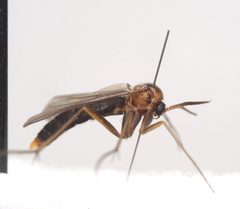
can be distinguished from other fungus gnat by the following combination of characters: do not meet above the (separating them from Sciaridae); wing venation with distinct patterns of the radial sector; and male terminalia with characteristic symmetrical gonostyli. The family is most readily separated from Mycetophilidae sensu stricto and related families (Keroplatidae, Bolitophilidae, Diadociidae) by detailed examination of wing venation, antennal structure, and male genitalia. Specimens of Ditomyia macroptera, the largest European , reach 8 mm in body length with uniformly smoky wings and dark brown to blackish coloration.
Images
Habitat
Associated with forested environments, particularly mature woodlands containing bracket fungi. Documented rearing records indicate development within fruiting bodies of polypore fungi. Specific records for Ditomyia macroptera include mountain forests at elevations around 850 m and old orchards.
Distribution
Worldwide except Afrotropical Region. Primary diversity centers: Australasian and . Europe: two only—Ditomyia (Central Europe) and Symmerus (Northern Europe, to Palaearctic). Documented European countries include Germany, Poland, Czech Republic, Slovak Republic, Italy, Bulgaria, France, Denmark, Norway, and Sweden. A questionable record exists from Sakhalin Island (Russia).
Diet
Mycophagy (fungus-feeding). Larvae develop within fruiting bodies of bracket fungi (Polyporaceae). Documented fungi include Phellinus igniarius and Phellinus alni.
Host Associations
- Phellinus igniarius - larval development siteOriginal description record
- Phellinus alni - larval development siteBulgarian rearing record
Life Cycle
Complete with , larva, pupa, and stages. Larvae develop within fruiting bodies of bracket fungi. Adults emerge from fungal . Rearing events are exceptionally rare; only two documented rearing events for Ditomyia macroptera in the 150+ years since its description.
Ecological Role
Decomposer; contributes to nutrient cycling in forest through association with wood-decaying fungi.
Human Relevance
Minimal direct interaction with humans. Ditomyia macroptera is considered critically endangered in the Czech Republic due to loss and extreme rarity.
Similar Taxa
- MycetophilidaeHistorically included as a ; separated based on wing venation, antennal structure, and male genitalia. -level distinction requires expert examination.
- SciaridaeSimilar habitus and ; distinguished by contiguous above in Sciaridae versus separated eyes in .
- KeroplatidaeRelated fungus gnat split from Mycetophilidae sensu lato; requires detailed morphological examination for separation.
Sources and further reading
- BugGuide
- Wikipedia
- GBIF taxonomy match
- iNaturalist taxon
- NCBI Taxonomy
- Catalogue of Life
- An elegant Eocene fly | Beetles In The Bush
- New European records of Ditomyia macroptera Winnertz (Diptera: Ditomyiidae) with notes on its distribution
- Figure 2 from: Kurina O, Chandler P (2018) New European records of Ditomyia macroptera Winnertz (Diptera: Ditomyiidae) with notes on its distribution. Biodiversity Data Journal 6: e24857. https://doi.org/10.3897/BDJ.6.e24857
- Figure 1 from: Kurina O, Chandler P (2018) New European records of Ditomyia macroptera Winnertz (Diptera: Ditomyiidae) with notes on its distribution. Biodiversity Data Journal 6: e24857. https://doi.org/10.3897/BDJ.6.e24857
- Figure 3 from: Kurina O, Chandler P (2018) New European records of Ditomyia macroptera Winnertz (Diptera: Ditomyiidae) with notes on its distribution. Biodiversity Data Journal 6: e24857. https://doi.org/10.3897/BDJ.6.e24857