
Porricondylinae
gall midges, wood midges
Tribe Guides
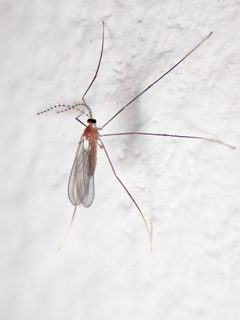
2Porricondylinae is a of gall midges and wood in the Cecidomyiidae (Diptera). Members are primarily mycophagous (fungus-feeding), with larvae developing in decaying wood, fungi, or other organic substrates. The subfamily contains three tribes—Asynaptini, Dicerurini, and Porricondylini—encompassing over 100 described . Many exhibit distinctive roosting on spider webs, where they suspend themselves from non-sticky foundation threads to avoid .
Pronunciation
How to pronounce Porricondylinae: /ˌpɔrɪkɒnˈdɪlaɪniː/
These audio files are automatically generated. While they are not always 100% accurate, they are a good starting point.
Identification
Porricondylinae are small, delicate flies typical of Cecidomyiidae, with reduced wing venation and long, bead-like . Male genitalia show extraordinary structural diversity, particularly in Asynaptini, with complex paramere arrangements that serve as critical diagnostic features. Larvae are maggot-like with reduced capsules. Identification to or requires microscopic examination of adult , particularly male terminalia; females are often difficult to identify due to less differentiated genitalic structures.
Images
Habitat
Ancient, naturally grown forest remnants; specifically small-area remnants with established fungal . Larval include decaying wood, fungi, and decomposing organic matter. frequently encountered in catches in forested environments.
Distribution
Holarctic distribution with centers of diversity in northern Europe, particularly Sweden, Finland, and Estonia. Extensive fossil record from Eocene Baltic and Rovno amber (Ukraine), and Barremian Lebanese amber, indicating long evolutionary history.
Seasonality
activity primarily recorded May through August in northern European , based on inventories.
Diet
Mycophagous; larvae feed on fungi. Specific fungal are largely undocumented for most .
Life Cycle
Complete with , larval, pupal, and stages. Larval development occurs within fungal substrates or decaying wood. details are poorly documented for most .
Behavior
of many roost on spider webs, selecting non-sticky foundation threads to suspend themselves. This , first reported in 1853, appears widespread in the and functions as an anti- strategy—predators attempting to capture the risk entanglement in the web. Males possess elaborate genitalic structures used in mating.
Ecological Role
Decomposers and fungivores in forest ; contribute to nutrient cycling through consumption of fungal . Serve as prey for spiders and other despite web-roosting .
Similar Taxa
- CecidomyiinaeBoth are of Cecidomyiidae; Cecidomyiinae are primarily gall-forming on plants, whereas Porricondylinae are mycophagous and non-gall-forming. Porricondylinae lack the plant- associations characteristic of most Cecidomyiinae.
- LestremiinaeAnother mycophagous of Cecidomyiidae with similar preferences; distinguished by differences in and larval , particularly wing venation and antennal structure. Porricondylinae show greater diversity in male genitalic morphology.
- MicromyinaeSmall mycophagous Cecidomyiidae with overlapping use; Micromyinae typically have different antennal segmentation and reduced palpal segments. Accurate separation requires microscopic examination.
Sources and further reading
- BugGuide
- Wikipedia
- iNaturalist taxon
- NCBI Taxonomy
- Catalogue of Life
- Bug Eric: Spider Sunday: Thieves and Hangers-on
- New Dicerurini from Europe, mostly Sweden (Diptera: Cecidomyiidae, Porricondylinae)
- New and rarely found species of asynaptine Porricondylinae (Diptera: Cecidomyiidae) in northern Europe
- New species and new distribution records of Lestremiinae, Micromyinae and Porricondylinae (Diptera: Cecidomyiidae) in Sweden
- The Porricondylini (Diptera: Cecidomyiidae: Porricondylinae) of Sweden revisited: descriptions of nineteen new species of ten genera, including a new genus