
Rhopalomyia floccosa
(Felt, 1916)
Sagebrush Woolly Stem Gall Midge
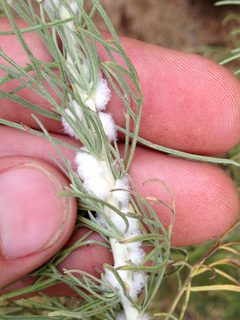
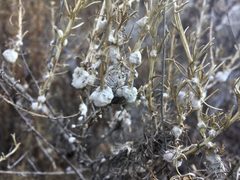
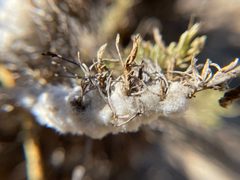
Rhopalomyia floccosa is a gall midge in the Cecidomyiidae that induces distinctive woolly stem galls on California sagebrush (Artemisia californica). The produces white, woolly, monothalamous bud galls measuring approximately 5 mm in diameter individually, with coalescing galls reaching 30–40 mm in length. It is a herbivore with a known association limited to this single plant.
Pronunciation
How to pronounce Rhopalomyia floccosa: /roʊˌfælɵˈmaɪə flɒˈkoʊsə/
These audio files are automatically generated. While they are not always 100% accurate, they are a good starting point.
Identification
Galls induced by this are white and woolly in texture, with individual galls measuring about 5 mm in diameter. Coalescing galls may extend 30–40 mm in length. The galls are monothalamous (single-chambered) bud galls on stems. These characteristics distinguish R. floccosa from other Rhopalomyia species that may induce different gall morphologies on Artemisia .
Images
Habitat
Found in where the plant Artemisia californica occurs, including coastal sage scrub, chaparral, and dry slopes in California and Baja California.
Distribution
Native to western North America, occurring in California and Baja California where its plant Artemisia californica is present.
Diet
Larvae feed within the gall tissue induced on Artemisia californica. do not feed; their mouthparts are reduced or non-functional, as is typical for Cecidomyiidae.
Host Associations
- Artemisia californica - obligate California sagebrush; sole known plant for gall induction
Life Cycle
Development occurs within the woolly stem galls on Artemisia californica. Specific details of , larval, and pupal stages within the gall are not documented in available sources. emerge from galls to mate and oviposit on new growth.
Ecological Role
As a gall inducer, modifies plant growth and architecture, potentially affecting plant resource allocation. Provides microhabitat for and within galls, though specific associates are not documented in available sources.
Human Relevance
No direct economic or medical significance. Of interest to entomologists and naturalists studying plant-insect interactions and gall .
Similar Taxa
- Rhopalomyia spp.Other in the induce galls on Artemisia , but differ in gall , position, or host specificity. R. floccosa is distinguished by its white, woolly, monothalamous stem galls on Artemisia californica specifically.
More Details
Gall morphology
The specific epithet 'floccosa' refers to the woolly or floccose texture of the galls.