
Paradiplosis
Felt, 1908
balsam gall midge (for P. tumifex)
Species Guides
1- Paradiplosis tumifex(balsam gall midge)
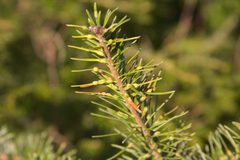
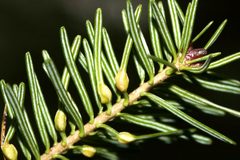
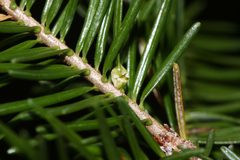
Paradiplosis is a of gall midges (Cecidomyiidae) containing at least four described . The genus is best known for P. tumifex, the balsam , which induces characteristic needle galls on balsam fir and is a significant pest in Christmas tree plantations. Other species include P. abietispectinatae, P. manii, and P. obesa. Species in this genus are associated with coniferous and exhibit specialized gall-inducing .
Pronunciation
How to pronounce Paradiplosis: /ˌpærədaɪˈpləʊsɪs/
These audio files are automatically generated. While they are not always 100% accurate, they are a good starting point.
Images
Habitat
Associated with coniferous forests and Christmas tree plantations; P. tumifex specifically inhabits balsam fir (Abies balsamea) stands where galls form on current-year needles.
Distribution
Eastern North America; documented in Québec, Canada and Vermont, United States. Specific distribution data for other is limited.
Seasonality
Spring ; occurs as larvae. P. tumifex exhibits spring linked to tree budburst, with potential asynchrony between emergence and budburst observed in some years.
Host Associations
- Abies balsamea - gall inducerP. tumifex induces needle galls on current-year needles; to Dasineura balsamicola
Life Cycle
Overwinters as larvae in . Gall development progresses through distinct stages: initial proliferation in epidermal and mesophyll tissue, followed by cell , tissue differentiation, and eventual lignification of epidermal and subepidermal layers. Mature galls are single-chambered with an ostiolar opening on the adaxial needle surface.
Behavior
Induces simple, single-chambered, prosoplasmic galls on adaxial surfaces of needles. Gall formation involves manipulation of host plant tissue development, with proliferating mesophyll surrounding the larva. Frequently associated with the Dasineura balsamicola, which inhabits galls and has been linked to declines of the gall-maker.
Ecological Role
Gall inducer creating specialized microhabitats on conifer foliage. Acts as to . P. tumifex functions as a pest species in managed Christmas tree plantations, causing premature needle abscission and host damage when galled needles dry and drop.
Human Relevance
P. tumifex is a major pest for the Christmas tree industry, causing economic damage through gall formation and premature needle loss. Management strategies must account for differences in between the gall-maker and its .
Similar Taxa
- Dasineura balsamicolaFrequently co-occurs in P. tumifex galls as an ; distinguished by different strategy and ecological role
- Other Cecidomyiidae gall midgesSimilar and ; distinguished by specificity and gall characteristics on conifer needles
More Details
Gall morphology
P. tumifex galls are characterized by retention of starch in gall after starch depletion in surrounding tissues. The vascular bundle remains unaffected by gall formation, but resin duct lining cells are altered.
Population dynamics
Spring sex ratio is strongly female-biased in P. tumifex, and this may be influenced by conditions. episodes have been documented in eastern Canada.
Taxonomic note
The was established by Felt in 1908. A new was described in 1978 (P. tumifex Gagné), indicating ongoing taxonomic refinement.
Sources and further reading
- BugGuide
- Wikipedia
- GBIF taxonomy match
- iNaturalist taxon
- Catalogue of Life
- Morphology of the balsam fir needle gall induced by the midge Paradiplosis tumifex (Diptera: Cecidomyiidae)
- Biology and Taxonomy of Two Gall Midges (Diptera: Cecidomyiidae) Found in Galls on Balsam Fir Needles with Description of a New Species of Paradiplosis
- Gall-maker Paradiplosis tumifex (Diptera: Cecidomyiidae) and its inquiline Dasineura balsamicola (Diptera: Cecidomyiidae): an update on epidemic episodes and seasonal ecology in Québec, Canada