
Heteropogon divisus
(Coquillett, 1902)
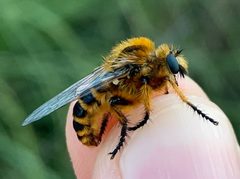
Heteropogon divisus is a of robber fly in the Asilidae, Brachyrhopalinae. The Heteropogon comprises small to medium-sized robber flies with distinctive courtship . are predatory, capturing other insects in and feeding on them using . The species was described by Coquillett in 1902.
Pronunciation
How to pronounce Heteropogon divisus: //ˌhɛt.əˈroʊ.pəˌɡɒn dɪˈvaɪ.səs//
These audio files are automatically generated. While they are not always 100% accurate, they are a good starting point.
Identification
Members of the Heteropogon can be distinguished from other Asilidae by their characteristic courtship , in which males hover before females and stroke the female's with ornamented front . Specific identification of H. divisus requires examination of morphological details including wing venation, leg ornamentation, and genitalia. The is smaller and more slender than many common robber flies, typically around 10 mm in length.
Images
Diet
are predatory, feeding on other insects captured in . Prey typically includes small flying insects such as winged ants and other dipterans. The are used to inject digestive and extract liquefied tissues from prey.
Behavior
Males exhibit elaborate aerial . The female perches on elevated vegetation while the male hovers before her with hind legs spread wide, possibly to display coloration. The male uses ornamented setae on his front to stroke the female's during courtship. If accepted, the male alights beside the female. are sit-and-wait that perch on twig tips and sally forth to capture flying prey.
Ecological Role
As a predatory insect, H. divisus contributes to regulation of of small flying insects. The occupies a mid-level trophic position in of its .
Human Relevance
Robber flies including Heteropogon are beneficial insects that help control of other insects. They are of interest to entomologists studying predatory and . The distinctive aerial courtship of Heteropogon species makes them accessible subjects for behavioral observation and photography.
Similar Taxa
- Heteropogon macerinusSimilar size, preference for forest edges, and shared -level courtship involving male hovering and tarsal stroking of female . H. macerinus has been more frequently observed and documented.