
Beameromyia bifida
(Hardy, 1942)
Notch-tailed Pixie
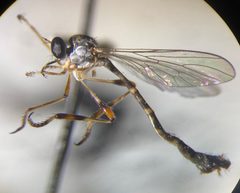
Beameromyia bifida is a of robber fly ( Asilidae) first described by Hardy in 1942 under the basionym Leptogaster bifidus. It is commonly known as the Notch-tailed Pixie. The species belongs to the Beameromyia, a group of small, delicate robber flies sometimes referred to as 'pixies' due to their diminutive size and agile . As with other Asilidae, it is a predatory fly, though specific ecological details remain poorly documented.
Pronunciation
How to pronounce Beameromyia bifida: /biˈmɛroʊˌmaɪə ˈbɪfɪdə/
These audio files are automatically generated. While they are not always 100% accurate, they are a good starting point.
Identification
The specific epithet 'bifida' (meaning 'cleft' or 'divided in two') suggests a notched or forked condition of some structure, likely the or a terminal appendage, which would serve as a key diagnostic feature distinguishing this from . Members of Beameromyia are generally small, slender robber flies with reduced wing venation compared to larger asilids. Definitive identification requires examination of male terminalia and comparison with .
Images
Distribution
Specific distribution records for B. bifida are sparse. The Beameromyia is primarily Nearctic in distribution, with recorded from western North America. The original description by Hardy (1942) and the basionym Leptogaster bifidus suggest western North American origins, though precise locality data require verification from original type material.
Ecological Role
As a member of the Asilidae, B. bifida functions as an aerial of other small arthropods. Robber flies are generally considered beneficial insects in natural and agricultural due to their on various pest insects, though the specific impact of this small, presumably - remains unstudied.
Similar Taxa
- Beameromyia speciesOther members of this small share the general 'pixie' —small size, slender build, and delicate —requiring careful examination of genitalic structures for definitive separation.
- Leptogaster speciesThe original placement in Leptogaster reflects similarity to this of small, gracile robber flies; B. bifida was subsequently transferred to Beameromyia based presumably on male genitalic and wing venation characters.
More Details
Taxonomic History
The was originally described as Leptogaster bifidus by Hardy in 1942, then subsequently transferred to the Beameromyia, a genus established to accommodate a group of small, delicate Nearctic robber flies previously confused with Leptogaster. The genus name honors R.H. Beamer, an American entomologist who worked extensively on Diptera .
Data Deficiency
This is extremely poorly known in the literature. As of the knowledge cutoff, no peer-reviewed publications specifically treating the , , or distribution of B. bifida could be located. The single iNaturalist observation suggests it remains rarely encountered or underreported, consistent with many small, - Asilidae.