
Laphria virginica
(Banks, 1917)
Laphria virginica is a of robber fly in the Laphria, commonly known as the '-like robber flies' for their resemblance to bumble bees. The species was described by Banks in 1917. Like other members of the genus, it exhibits mimicry of Hymenoptera, which may serve as a defensive against .
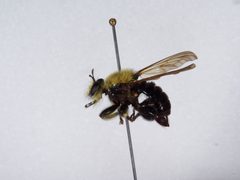
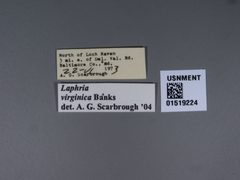
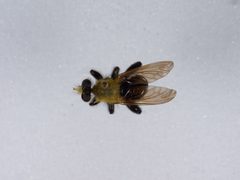
Pronunciation
How to pronounce Laphria virginica: //ˈlæf.ri.ə vərˈdʒɪ.nɪ.kə//
These audio files are automatically generated. While they are not always 100% accurate, they are a good starting point.
Identification
Members of the Laphria are distinguished from other robber fly genera by their thick (the terminal segment is not thin). They are separated from the superficially similar -mimicking genus Mallophora by this antennal character; Mallophora possess a thin terminal antennal segment. Laphria species also tend to have a more robust, hairier appearance compared to the generally smoother-bodied Mallophora.
Images
Distribution
The specific distribution of Laphria virginica is not documented in the provided sources. The Laphria occurs in North America.
Similar Taxa
- MallophoraBoth are effective mimics with similar overall appearance. Distinguished by antennal structure: Laphria has thick throughout, while Mallophora has a thin terminal antennal segment.
More Details
Mimicry context
Laphria , including L. virginica, are noted among the most realistic mimics in North American Diptera. This mimicry likely provides protection from vertebrate that avoid stinging Hymenoptera.