
Laphria sadales
Walker, 1849
Red-legged Laphria
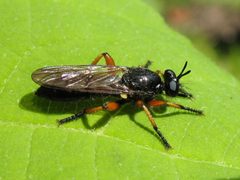
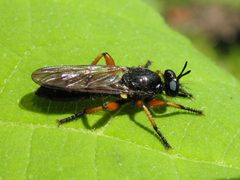
Laphria sadales is a of robber fly in the Asilidae, commonly known as the Red-legged Laphria. It belongs to a noted for effective mimicry, with several species resembling bees in appearance and . The species has been documented in the northeastern United States, including Vermont. Like other robber flies, it is presumed to be an aerial , though specific behavioral and ecological details for this species remain poorly documented.
Pronunciation
How to pronounce Laphria sadales: //ˈlæf.ri.ə səˈdeɪliːz//
These audio files are automatically generated. While they are not always 100% accurate, they are a good starting point.
Identification
Members of the Laphria can be distinguished from the similar -mimicking genus Mallophora by their thick (Mallophora has a thin terminal segment on the antennae). Specific identification of L. sadales requires examination of detailed morphological characters not summarized in available sources. Differentiation from likely relies on subtle differences in coloration, leg structure, and genitalia.
Images
Appearance
As a member of the Laphria, likely exhibits mimicry with a hairy body, robust , and thick . Specific morphological details for L. sadales are not well documented in available sources.
Distribution
Documented from Vermont and elsewhere in the United States. Specific range boundaries are not well established.
Behavior
As a Laphria , may exhibit behavioral mimicry of bumble bees including direct patterns between flowers without feeding, though this has not been specifically documented for L. sadales.
Similar Taxa
- Mallophora speciesBoth are effective mimics; distinguished by structure (Laphria has thick antennae, Mallophora has thin terminal segment)
- Other Laphria species share mimicry and general body plan; require detailed morphological examination for separation
More Details
Taxonomic note
The specific epithet 'sadales' and full authorship 'Walker, 1849' are consistently recorded across taxonomic databases including GBIF, Catalogue of Life, and NCBI.