
Laphria janus
McAtee, 1919
Orange-tailed Laphria
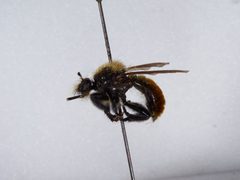
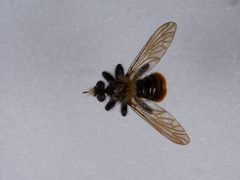
Laphria janus is a of robber fly in the Asilidae, described by McAtee in 1919. The species is recognized by its "Orange-tailed Laphria," referring to a distinctive coloration feature. Like other members of the Laphria, it exhibits mimicry as a defensive . The species has been documented in the northeastern United States, particularly Vermont.
Pronunciation
How to pronounce Laphria janus: /ˈlæf.ri.ə ˈdʒeɪ.nəs/
These audio files are automatically generated. While they are not always 100% accurate, they are a good starting point.
Identification
The "Orange-tailed Laphria" suggests the presence of orange coloration on the terminal abdominal segments, which likely serves as a key distinguishing feature from . As a mimic, Laphria janus presumably possesses dense, pale setae creating a fuzzy appearance similar to bees in the Bombus. Definitive identification likely requires examination of male terminalia or other subtle morphological characters, as is typical for the genus.
Images
Distribution
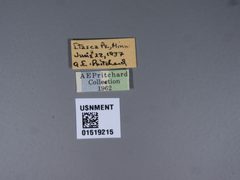
Northeastern United States; documented from Vermont.
Behavior
As a member of the Laphria, this likely exhibits ambush , perching on vegetation or other substrates to detect flying prey. mimicry in Laphria species functions in two ways: deterring potential that associate the coloration with defensive stinging, and allowing closer approach to pollinating insects that mistake the fly for a harmless .
Ecological Role
As a predatory robber fly, this contributes to regulation of insect . Its mimicry represents an example of within its .
Similar Taxa
- Other Laphria speciesMultiple Laphria exhibit mimicry with similar color patterns; orange terminal abdominal segments may distinguish L. janus from .
- Mallophora speciesAnother of -mimicking robber flies; Mallophora have more slender terminal antennal segments and generally hairier bodies than Laphria.
- Bombus species (bumble bees)Visual mimicry is strong; behavioral differences in and structure (flies have short antennae with , bees have long, elbowed antennae) allow distinction.
More Details
Etymology
The specific epithet "janus" refers to the Roman god Janus, typically depicted with two . This may allude to the dual nature of the ' appearance—both as a fly and as a mimic.