
Laphria flavicollis
Say, 1824
Black-tailed Laphria
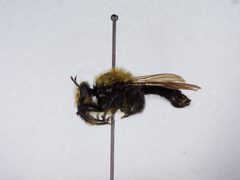
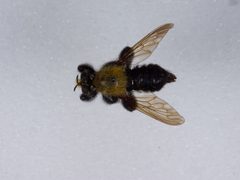
Laphria flavicollis is a of robber fly in the Asilidae. It is recognized as a mimic, using its appearance to deceive both and prey. The species has been documented in deciduous woodland and is known to occur in the eastern United States. It belongs to a noted for particularly effective mimicry of bumble bees.
Pronunciation
How to pronounce Laphria flavicollis: //ˈlæf.ɹi.ə ˌflæv.ɪˈkoʊ.lɪs//
These audio files are automatically generated. While they are not always 100% accurate, they are a good starting point.
Identification
Distinguished from other -mimicking flies by its thick ; Mallophora have thin terminal antennal segments. Distinguished from actual bumble bees by : Laphria flies more directly between perches without the hovering, nectar-seeking behavior of bees. Distinguished from syrphid fly mimics by larger size and predatory perching behavior.
Images
Habitat
Deciduous woods; observed along woodland edges and paved trails near wooded areas
Distribution
Eastern United States; documented in Vermont, Kansas, and Illinois
Seasonality
Active in spring and early summer; observed in May in Illinois and Kansas
Diet
Behavior
Perches on vegetation to spot prey; captures small flying beetles in mid-air and returns to a perch to feed. pattern is more direct than that of bumble bees, which it mimics.
Ecological Role
Aerial ; contributes to regulation of small . Its mimicry may reduce pressure from vertebrate predators while allowing close approach to prey.
Human Relevance
Subject of interest for entomologists and naturalists due to its convincing mimicry; no documented economic or medical significance
Similar Taxa
- MallophoraAlso -mimicking robber flies, but distinguished by thin terminal antennal segments versus thick in Laphria
- BombusActual bumble bees; distinguished by hovering at flowers, feeding on nectar, and less direct flight pattern
- SyrphidaeFlower flies include mimics, but are generally smaller, have different wing venation, and lack the predatory perching of robber flies
More Details
Mimicry effectiveness
The mimicry serves dual purposes: avoid the fly assuming it can sting, while prey (particularly ) allow close approach believing the fly is a harmless seeking nectar
Taxonomic note
described by Thomas Say in 1824, an early American entomologist who described numerous North American insects