
Laphria columbica
Walker, 1866
Columbian Bee Killer
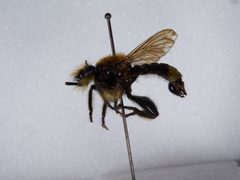
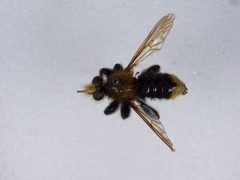
Laphria columbica is a of robber fly in the Asilidae, described by Francis Walker in 1866. The Laphria is notable for species that are effective mimics of bumble bees, and L. columbica appears to follow this pattern. Robber flies in this genus are predatory and often observed perching on vegetation while hunting. The specific epithet "columbica" suggests a connection to the Columbia River region or British Columbia, though the exact etymology is not documented in available sources.
Pronunciation
How to pronounce Laphria columbica: /ləˈfriːə koʊˈlʌmbɪkə/
These audio files are automatically generated. While they are not always 100% accurate, they are a good starting point.
Identification
Laphria are distinguished from other -mimicking robber flies by their thick ; Mallophora, another of mimics, has thin terminal segments on the antennae and is generally hairier. Laphria columbica specifically may be separated from by geographic range and subtle differences in coloration and pattern, though detailed diagnostic features are not well documented in accessible literature.
Images
Distribution
The specific distribution of Laphria columbica is not well documented in available sources. The Laphria is broadly distributed across North America, with many occurring in western regions of the continent. The epithet "columbica" suggests possible association with the Pacific Northwest or British Columbia region.
Similar Taxa
- Mallophora spp.Both contain effective mimics, but Mallophora has thin terminal antennal segments and denser body hair, while Laphria has uniformly thick .
- Promachus spp.Large predatory robber flies that may overlap in size, but Promachus lacks the dense and -mimic coloration of Laphria.