
Laphria aimatis
McAtee, 1919
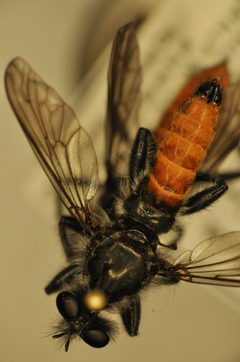
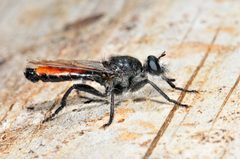
Laphria aimatis is a of robber fly in the Asilidae, described by McAtee in 1919. The Laphria includes species known for their effective mimicry of bumble bees (Bombus), with which they share similar coloration and hairiness. These flies are predatory as and are often observed perching on vegetation while hunting for prey. The specific epithet 'aimatis' appears to be derived from Greek, though its precise meaning in this context is not documented in available sources.
Pronunciation
How to pronounce Laphria aimatis: /ˈlæf.ri.ə ˈaɪ.mə.tɪs/
These audio files are automatically generated. While they are not always 100% accurate, they are a good starting point.
Identification
Laphria are distinguished from other -mimicking robber flies by their thick, robust (terminal segment not thin or elongated). They differ from Mallophora, another bumble bee mimic , which has distinctly thin terminal antennal segments and generally hairier bodies. Laphria aimatis specifically may be distinguished from by subtle differences in coloration and setal patterns, though precise diagnostic features require examination of type material or original description.
Images
Distribution
Known from North America; specific locality data for Laphria aimatis is sparse in available sources. The Laphria is broadly distributed across North America, with many associated with forested and edge .
Similar Taxa
- MallophoraBoth are effective mimics with similar coloration; distinguished by antennal structure—Mallophora has thin terminal antennal segments, while Laphria has thick, robust .
- PromachusBoth are large Asilidae; Promachus lacks the dense hairiness and -like coloration of Laphria, and has different antennal and facial characteristics.