
Saropogon
Loew, 1847
robber flies, assassin flies
Species Guides
15Saropogon is a of predatory robber flies (Asilidae) comprising at least 128 described globally. The genus is distinguished by a stout, often twisted spur at the antero- apex of the fore tibiae, open m3 on the wing, and an antennal stylus with a single element. Nearctic species north of Mexico include 19 recognized species, with many exhibiting pronounced in coloration and wing patterns. are venomous aerial that immobilize prey through initiated by injected venom.
Pronunciation
How to pronounce Saropogon: /ˌsæroʊˈpoʊɡɒn/
These audio files are automatically generated. While they are not always 100% accurate, they are a good starting point.
Identification
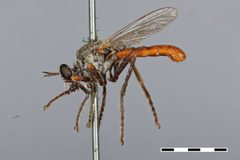
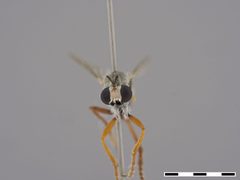
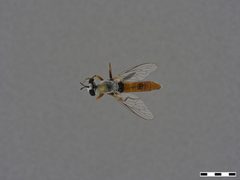
Key diagnostic features include: (1) fore tibia with a stout, often twisted spur at the antero- apex; (2) wing with open m3; (3) antennal stylus composed of a single element. is pronounced in many Nearctic : males typically possess black and brown wings with long erect hairs on the , abdomen, and legs; females typically have red abdomens and yellowish wings with short, appressed, inconspicuous hairs. Body length ranges 10–27 mm. An updated key to Nearctic species north of Mexico is available (Alberts 2021).
Images
Habitat
Primarily arid and semi-arid regions of the southwestern United States including Texas, Arizona, New Mexico, and California. Occurs in adjacent states with scattered extending north to Colorado and Nebraska. Found in both temperate and tropical climatic zones. Specific microhabitat preferences within these regions are not well documented.
Distribution
Nearctic region north of Mexico: concentrated in southwestern USA (Arizona, Texas, New Mexico, California) with disjunct in adjacent states; northern distributional limit in Colorado and Nebraska; southern limit extends into Nayarit, Mexico. Palearctic distribution includes Russia (Kalmykia), Transcaucasia (Azerbaijan, Armenia), and Central Asia (Tajikistan). Global distribution encompasses temperate and tropical regions with at least 128 described .
Diet
Preys primarily on Hymenoptera. Specific observations document Saropogon combustus and S. pritchardi showing particular preference for Hymenoptera. The Asilidae as a whole is characterized by with specialized prey preferences having evolved independently multiple times; whether this generalization applies specifically to Saropogon requires further study.
Behavior
are active aerial that use venom to immobilize prey and initiate . Many Nearctic exhibit strong in coloration and wing patterns, with males often displaying long erect hairs on the , , and legs while females have short appressed inconspicuous hairs. Wing color dimorphism is marked in many species: males typically brown-winged, females yellowish-winged. Larval is unknown; Asilidae larvae are generally soil-dwelling or found in decaying wood.
Ecological Role
Serves as a venomous aerial in . As members of the Asilidae, in this function as top predators in their respective , potentially influencing hymenopteran through pressure. Specific quantitative impacts on processes have not been documented.
Human Relevance
Subject of taxonomic research; a Nearctic review and new description (S. pyrodes from Arizona) was published in 2021 following scientist documentation via iNaturalist and BugGuide, demonstrating the value of citizen science in species discovery. One species awaited description for 57 years after its initial collection in 1964. No economic importance to agriculture or human health has been documented.
Similar Taxa
- Other Asilidae generaDistinguished by the combination of: stout twisted fore tibial spur, open m3, and single-element antennal stylus. Many Nearctic Saropogon can be further recognized by the distinctive in abdominal color (black males, red females) and wing coloration (brown males, yellowish females).
- Dasypogoninae generaShares Dasypogoninae but differs in the specific configuration of the fore tibial spur and antennal stylus structure; precise differentiation requires examination of these key morphological characters.
Sources and further reading
- BugGuide
- Wikipedia
- GBIF taxonomy match
- iNaturalist taxon
- NCBI Taxonomy
- Catalogue of Life
- For the Love of Robber Flies | Bug Squad
- The Day that Mama Became a Wizard | Bug Squad
- Times Flies When You're Studying Flies! Bohart Museum Open House Jan. 12 | Bug Squad
- UC Davis Entomology and Nematology's Fall Seminars Begin Monday, Oct. 2 | Bug Squad
- Charlotte Alberts and Those Fascinating Assassin Flies | Bug Squad
- A new species of Saropogon Loew, 1847 (Diptera, Asilidae) from Arizona, with a review of the Nearctic species north of Mexico
- Review of the genus Saropogon Loew, 1847 (Diptera: Asilidae) from Russia, Transcaucasia and Central Asia, with description of three new species