
Diogmites esuriens
Bromley, 1936
Short-striped Hanging Thief
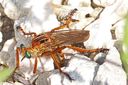
Diogmites esuriens is a of robber fly in the Asilidae, commonly known as the Short-striped Hanging Thief. The Diogmites is notable for the distinctive 'hanging' of its members, which often dangle from their front or middle legs while manipulating prey with the remaining legs. This species was described by Bromley in 1936 and belongs to the Dasypogoninae.
Pronunciation
How to pronounce Diogmites esuriens: //daɪˈɒɡmaɪtiːz eˈsʊriˌɛnz//
These audio files are automatically generated. While they are not always 100% accurate, they are a good starting point.
Identification
Members of the Diogmites can be recognized by their habit of hanging from vegetation by their forelegs or midlegs while feeding, a that has earned them the 'hanging thieves.' Specific identification of D. esuriens requires examination of abdominal striping patterns and other subtle morphological features. The epithet 'esuriens' (Latin for 'hungry' or 'greedy') may allude to its predatory nature or feeding behavior. Diogmites species generally have a slender build with relatively long legs compared to other robber flies.
Images
Diet
As a robber fly, Diogmites esuriens is an active aerial of other insects. Members of the Diogmites have been observed capturing prey including butterflies and other flying insects, which they subdue with their piercing mouthparts.
Life Cycle
Like other Asilidae, Diogmites esuriens undergoes complete with , larval, pupal, and stages. The larvae of Dasypogoninae, including Diogmites, are believed to be predatory, though specific details of the stages of D. esuriens are not well documented.
Behavior
The most distinctive of Diogmites , including D. esuriens, is the 'hanging' posture: after capturing prey, the fly hangs suspended from a perch by its front or middle pair of legs while using the remaining legs to manipulate and consume the prey. This behavior is unique among robber flies and is the basis for the 'hanging thief.'
Ecological Role
As a predatory insect, Diogmites esuriens functions as an aerial in its , helping to regulate of other flying insects.
Similar Taxa
- Other Diogmites speciesShare the distinctive hanging and general body plan; require careful examination of abdominal patterning and other morphological details for separation.
- Other Dasypogoninae robber fliesSimilar predatory habits and general appearance, but lack the characteristic hanging of Diogmites.
More Details
Etymology
The specific epithet 'esuriens' is Latin for 'hungry' or 'greedy,' likely referring to the ' voracious predatory habits.
Taxonomic history
Described by S.W. Bromley in 1936, a prominent dipterist who authored major works on Laphriinae and other Asilidae.
Sources and further reading
- BugGuide
- Wikipedia
- GBIF taxonomy match
- iNaturalist taxon
- Catalogue of Life
- T.G.I.Flyday – Andrenosoma fulvicaudum | Beetles In The Bush
- T.G.I.Flyday | Beetles In The Bush
- Bug Eric: Robber Flies
- Arkansas | Beetles In The Bush | Page 3
- Asilidae | Beetles In The Bush | Page 2
- July | 2011 | Beetles In The Bush | Page 2