
Ommatius ouachitensis
Bullington & Lavigne, 1984
robber fly, assassin fly
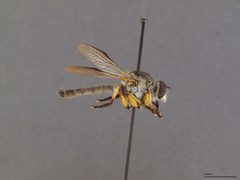
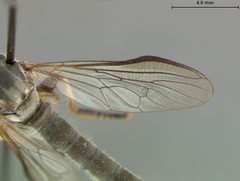
Ommatius ouachitensis is a of robber fly ( Asilidae) described by Bullington & Lavigne in 1984. As with other members of this large predatory fly family, it likely exhibits the characteristic hunting of intercepting insect prey in . The specific epithet "ouachitensis" suggests an association with the Ouachita Mountains or Ouachita River region of North America. Like other Ommatius species, it probably perches on vegetation in sunny locations to hunt.
Pronunciation
How to pronounce Ommatius ouachitensis: /ɔˈmeɪʃiəs oʊˌəˈʃɪtensis/
These audio files are automatically generated. While they are not always 100% accurate, they are a good starting point.
Images
Distribution
The specific epithet "ouachitensis" indicates this is associated with the Ouachita region, likely the Ouachita Mountains spanning Arkansas and Oklahoma, or the Ouachita River watershed in the south-central United States. Precise distribution records are not available in the provided sources.
Ecological Role
As a member of the Asilidae , this functions as a predatory insect, contributing to control of other flying insects. Robber flies are considered beneficial in natural and agricultural due to their role as of various insect prey.
Human Relevance
Robber flies including Ommatius are generally beneficial to humans as agents of pest insects. They pose minimal direct threat to humans, though large individuals may deliver a defensive bite if handled roughly, comparable to a sting in discomfort.
Similar Taxa
- Ommatius amulaAnother in the same with similar body plan and predatory ; both share the characteristic mystax (facial bristles) and perching hunting strategy typical of Ommatius robber flies.
- Other Asilidae generaMany robber fly share similar predatory and general body form, though Ommatius typically have distinctive patterns and leg spination that aid in genus-level identification.
More Details
Taxonomic context
The Ommatius is one of the largest genera within Asilidae, with distributed globally. Ommatius ouachitensis was described relatively recently (1984), suggesting it may be a regionally species with limited known range.
Research context
Doctoral candidate Charlotte Herbert Alberts at UC Davis has conducted research on Ommatius including O. amula, focusing on assassin fly , -prey dynamics, and venom evolution. This research context suggests that species-level revisions and behavioral studies of Ommatius are active areas of investigation.
Sources and further reading
- BugGuide
- Wikipedia
- GBIF taxonomy match
- iNaturalist taxon
- Catalogue of Life
- Something Wonderful Is Happening Saturday, Jan. 18 at Bohart Museum of Entomology | Bug Squad
- Why You Should Celebrate World Robber Fly Day | Bug Squad
- Times Flies When You're Studying Flies! Bohart Museum Open House Jan. 12 | Bug Squad