
Mallophora fautrix
Osten Sacken, 1887
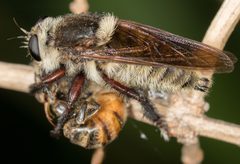
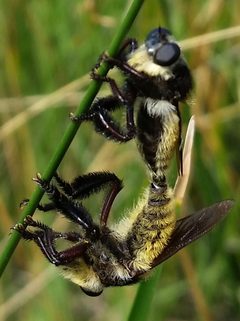
Mallophora fautrix is a of robber fly in the Asilidae. It belongs to a known for effective mimicry, with species often exhibiting hairy bodies and distinctive antennal structures. The species was described by Osten Sacken in 1887. Like other Mallophora species, it is presumed to be a predatory fly, though specific ecological details for this species are not well documented in available sources.
Pronunciation
How to pronounce Mallophora fautrix: //ˌmæloʊˈfɔːrə ˈfɔːtrɪks//
These audio files are automatically generated. While they are not always 100% accurate, they are a good starting point.
Identification
Mallophora can be distinguished from the similar -mimicking Laphria by their hairier bodies and thin terminal antennal segments; Laphria has thick . Mallophora fautrix specifically has not been described in detail in available sources, but as a member of Mallophora, it likely shares the genus-typical dense pilosity and mimicry coloration. Positive identification to species level requires examination of specific morphological characters not summarized in general sources.
Images
Distribution
The specific distribution of Mallophora fautrix is not detailed in available sources. The Mallophora occurs in North America, with various found in prairie and grassland .
Similar Taxa
- LaphriaBoth are effective mimics with similar overall appearance, but Mallophora has thin terminal antennal segments and denser hair coverage compared to Laphria's thick .
More Details
Taxonomic note
The Mallophora contains multiple -mimicking that are not particularly closely related to Laphria, despite of similar mimicry. The thin terminal antennal segment is a key diagnostic feature for the genus, though this character is shared with many other Asilidae and is not unique to Mallophora.